Swimming With Arthritis: A Guide for Adult Learners
If stiff knees, hips or hands have you looking at the pool, swimming with arthritis is worth a serious look, even if you never learned to swim as a kid. Water carries part of your body weight, so you can move joints that complain on land, and you can learn the skills at your own pace.
This guide is for adults who want to learn to swim, or get back to it, while living with arthritis. It covers what the research says, what to ask your doctor, how to pick a pool, which strokes and gear tend to feel easier, a gentle first month plan, and how to tell normal soreness from a sign to back off.
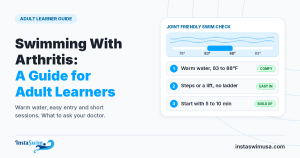
For most adults, yes. The CDC lists swimming and water activities as joint friendly ways to ease arthritis pain, and you do not need to be a strong swimmer to start. Check with your doctor first, choose a warm pool with easy entry, start with short sessions, and build slowly.
Is swimming with arthritis a good idea? What the research says
Arthritis is common. A CDC data brief found that 18.9% of US adults had diagnosed arthritis in 2022, rising from 3.6% of adults ages 18 to 34 to 53.9% of adults 75 and older. Women reported it more often than men (21.5% versus 16.1%). So if you are an adult thinking about lessons and your joints are part of the conversation, you are in large company.
The CDC recommends that adults with arthritis aim for at least 150 minutes a week of moderate aerobic activity plus muscle strengthening on at least 2 days, and it names swimming among the low impact, joint friendly options. The CDC also says that even 5 or 10 minutes at a time counts, which matters when you are building up from very little.
The water specific evidence is encouraging but modest. A 2016 Cochrane review pooled 13 trials with 1,190 people who had knee or hip osteoarthritis. People who finished an aquatic exercise program rated their pain and disability about 5 points lower on a 0 to 100 scale, and their quality of life about 7 points higher, than people who did not. The authors called the evidence moderate quality and the benefit slight, with no serious side effects reported. The Arthritis Foundation also summarizes reviews showing water workouts can ease pain and improve function in both osteoarthritis and inflammatory arthritis.
The honest takeaway: water is not a cure, but it is one of the easiest places to get moving, and moving is what the guidance asks for.
| Finding | What it means for you | Source |
|---|---|---|
| Swimming and water activities are joint friendly | A reasonable place to start moving more | CDC |
| 150 min a week of moderate activity, plus strength 2 days | A long term target, not a week one goal | CDC |
| 5 or 10 minutes at a time still counts | Short first sessions are fine | CDC |
| Pain and disability about 5 points lower out of 100 after aquatic exercise | A small, real benefit for knee and hip osteoarthritis | Cochrane review, 2016 |
| No serious side effects reported in the trials | Still clear it with your doctor first | Cochrane review, 2016 |
You do not need to swim to start
Plenty of adults with arthritis never learned to swim. The CDC reported in 2024 that 15.4% of US adults say they do not know how to swim, rising to 18.6% of adults 65 and older, and 54.7% have never taken a swimming lesson. If that is you, there are two good doors into the water, and many people use both.
Water exercise class
- Group class in shallow, warm water
- Swimming ability is not required for the Arthritis Foundation Aquatic Program, per the CDC fact sheet
- Often 1 hour, 2 or 3 times a week
- Focus is movement and strength, not swim skills
Adult swim lessons
- One on one or small group, at your pace
- Builds floating, breathing, strokes and water safety skills
- Lets you use deeper water and lap swimming later
- Time can be shaped around how your joints feel that day
Learning to swim adds something a water exercise class does not: the ability to handle yourself if you end up in deeper water than you planned. Lessons are one layer of protection alongside supervision and life jackets, and you can see the full picture in our drowning statistics report. If nerves are the bigger hurdle than your joints, our guide to overcoming fear of water as an adult walks through it step by step.
Questions for your doctor first
Arthritis covers many conditions, from osteoarthritis to rheumatoid arthritis, gout and others, and only your own care team knows your joints, medicines and history. Bring these questions to your next visit:
- Is swimming or water exercise a good fit for me right now? Especially during a flare, or with a recently swollen joint.
- Are there movements I should avoid? For example, deep knee bends, strong kicks, or reaching overhead with a painful shoulder.
- I had a joint replaced. When can I swim? The American Academy of Orthopaedic Surgeons says swimming is an excellent low impact activity after knee replacement once the wound is healed enough, and that your doctor will tell you when.
- How warm should the water be for me? Some people feel better in warmer pools; others with heart or blood pressure concerns may get specific advice.
- How much soreness is OK after a session? Ask what to watch for and when to call.
Picking a pool that is kind to your joints
The pool matters as much as the plan. Water that is too cool can leave stiff joints tighter, and a tall ladder can be the hardest part of the whole session. Mayo Clinic Care Network guidance says pool temperatures of 83 to 88°F are usually comfortable for most types of water exercise, and University of Washington orthopedics guidance adapted from an Arthritis Foundation pamphlet gives the same range. For general lesson pool temperatures, see our guide to finding a pool for private swim lessons.
| Look for | Why it helps | Ask the pool |
|---|---|---|
| Warm water, around 83 to 88°F | Usually comfortable for water exercise | What temperature do you keep the water? |
| Steps, a ramp or a sloped entry | Easier on knees and hips than a vertical ladder | Is there a stair entry or a lift? |
| Chair lift | Some pools have one, per Versus Arthritis | Is the lift available during my session? |
| Shallow area at waist to chest depth | Water supports part of your weight while you can still stand | How deep is the shallow end? |
| Quiet times | More space to go slowly | When is the pool least busy? |
InstaSwim lessons happen at a home pool or a pool you can use, like a community, HOA, apartment or gym pool. InstaSwim does not own pools, so if you do not have one, you find one together with your instructor, and any pool fees go to the pool.
Strokes and gear that tend to feel easier
There is no single right stroke for arthritis. Versus Arthritis suggests mixing up strokes so different parts of the body share the work, and using flotation aids to rest one area while you work another. Talk through these options with your instructor and your doctor:
- Back float and backstroke. Your face stays out of the water, so there is no head turning to breathe. Many beginners start here.
- Gentle flutter kick from the hips. A relaxed, small kick asks less of the knees than a big whip kick.
- Breaststroke with care. The whip kick and lifted head bother some knees and necks. A flutter or dolphin style kick is a common swap; ask your doctor if knees are your issue.
- Front crawl with a snorkel. A center mount snorkel removes the need to turn your head to breathe, which some people with neck stiffness find easier.
- Kickboards, noodles and flotation belts. The Arthritis Foundation notes that kickboards and flotation vests may help if you are uncomfortable in the water.
- Water walking. Walking laps in the shallow end is a real workout and a good warm up.
A gentle first month
The CDC advice is to start slowly, pay attention to how your body feels, and increase difficulty in small steps. Adult beginners in our lesson guides usually need 2 to 4 lessons for water comfort and 8 to 12 for the basics, often at about 2 lessons a week. With arthritis, let your joints set the pace inside those ranges. Here is one way to shape the first four weeks, to adjust with your instructor:
Week 1: get comfortable
Easy entry, water walking, supported floats on your back and front, and breathing out into the water. Short sessions are fine; 5 or 10 minutes of activity still counts.
Week 2: floats and glides
Push and glide with a kickboard, small flutter kicks, and standing up from a float on your own.
Week 3: first strokes
Backstroke arms with a gentle kick, and short front stroke stretches with a snorkel or kickboard if your neck prefers.
Week 4: string it together
Short widths with rests, safety skills like turning to find the wall, and a plan for practice between lessons. See our guide on learning to swim as an adult for what comes next.
Normal soreness or a sign to back off
The CDC says some pain, stiffness or swelling is normal when you start a new activity, and that arthritis joint pain should improve over time as you keep going. If it does not, contact your health care provider.
A simple rule of thumb: University of Washington orthopedics guidance notes that pain lasting more than 1 to 2 hours after exercise may be a sign of overuse, and says to stop if pain suddenly increases. Next session, do less or go gentler. Sharp pain, a hot or newly swollen joint, or chest pain or shortness of breath are reasons to get out of the water and call your doctor.
A few habits help: arrive a little early so you can loosen up in the water first, keep the first and last few minutes easy, and log how you feel the next morning. That log is the best information you can give your instructor and your doctor.
Telling your instructor about your arthritis
When you book with InstaSwim, the booking form asks about health and needs so your instructor knows beforehand. The details are shared directly between you and your instructor. You and your doctor decide whether and how you take part; sharing it up front lets the lesson be shaped around your joints from day one.
- Read profiles closely. Instructors on InstaSwim are independent contractors who describe their own experience. Look for adult beginners or adaptive work in what they write, and ask about it.
- Share the practical details. Which joints, movements to avoid, how long you can comfortably stand, and how you get in and out of the pool.
- Agree on a signal. A simple way to say "let's rest" or "that hurts" so you never push through.
- Pick your lesson length. Shorter lessons can suit early weeks; our swim lesson cost guide shows current pricing so you can plan a budget.
Frequently asked questions
Is swimming good for arthritis?
For most adults, yes. The CDC lists swimming and water activities among joint friendly ways to ease arthritis pain, and a 2016 Cochrane review found aquatic exercise slightly reduced pain and disability in knee and hip osteoarthritis. Check with your doctor first, since arthritis types and flares differ.
Can I learn to swim as an adult if I have arthritis?
Yes. Many adults with arthritis start as beginners. Begin in warm, shallow water with easy entry, keep early sessions short, and let your instructor know which joints and movements to work around. Your doctor can tell you if anything should be avoided.
What is the best swimming stroke for arthritis?
There is no single best stroke. Many beginners find back floating and backstroke easiest because there is no head turning to breathe. Some people find the breaststroke kick hard on the knees. Versus Arthritis suggests mixing strokes so no one joint does all the work.
What water temperature is best for arthritis?
Mayo Clinic Care Network guidance says 83 to 88°F is usually comfortable for most types of water exercise, and many people with arthritis prefer the warmer end. Ask your doctor if you have heart or blood pressure concerns about warm water.
Is it normal to be sore after swimming with arthritis?
Some pain, stiffness or swelling is normal when you start a new activity, according to the CDC, and it should improve as you keep going. University of Washington guidance notes that pain lasting more than 1 to 2 hours afterward may mean you did too much. If pain does not improve, contact your health care provider.
Can I swim after a knee or hip replacement?
Often yes, once your surgeon clears you. The American Academy of Orthopaedic Surgeons calls swimming an excellent low impact activity after knee replacement once the wound has healed enough, and says your doctor will tell you when to begin.
Ready to learn at your own pace?
Browse independent instructors near you, read their self described experience, and choose who fits you and your joints.
Find Instructors Near YouSources
- CDC NCHS, Arthritis in Adults Age 18 and Older: United States, 2022 (Data Brief 497). Prevalence by age and sex.
- CDC, About Physical Activity and Arthritis. Activity targets, joint friendly activities, starting slowly, normal soreness.
- CDC, Exercise to Ease Arthritis Pain. Swimming and water activities as non drug ways to ease pain.
- CDC, Arthritis Foundation Aquatic Program provider fact sheet. Class format; swimming ability not required.
- Cochrane, Aquatic exercise for the treatment of knee and hip osteoarthritis (2016). 13 trials, 1,190 people, effect sizes and evidence quality.
- Arthritis Foundation, Water exercise benefits for arthritis. Research summaries and tips.
- Mayo Clinic Care Network, Water exercise: Does pool temperature matter?. 83 to 88°F comfort range.
- University of Washington Orthopaedics and Sports Medicine, Water Exercises. Temperature, buoyancy, overuse signs.
- Versus Arthritis, Top tips for swimming with arthritis (2022). Mixing strokes, flotation aids, pool access.
- AAOS OrthoInfo, Activities After Total Knee Replacement. Swimming once the wound has healed.
- CDC MMWR, Vital Signs: Drowning Death Rates, Self Reported Swimming Skill, Swimming Lesson Participation (2024). Adult swimming ability and lesson figures.
About this guide
Compiled by the InstaSwim team in October 2026 from CDC, Cochrane, Arthritis Foundation, Mayo Clinic Care Network, University of Washington, Versus Arthritis and AAOS sources listed above. Lesson counts are planning estimates that vary with each person's comfort, joints and practice. Instructors on the InstaSwim platform are independent contractors who describe their own methods and experience. Swim lessons are one layer of protection, and no one is ever drown proof. This guide is general information and is not medical advice; decide with your doctor whether and how to swim with your condition.