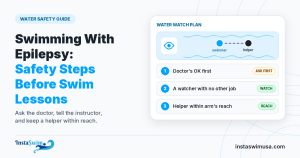
Swimming With Epilepsy: Safety Steps Before Swim Lessons
If you or your child has seizures, swimming with epilepsy can feel like a question nobody gives a straight answer to. Some families hear "never go in the water," others hear "it is fine, just be careful," and neither tells you what careful actually looks like at a pool on a Tuesday afternoon.
This guide pulls together what epilepsy organizations, children's hospitals and drowning researchers say: whether lessons make sense, what the risk numbers mean, what to ask the neurologist, what to tell an instructor, and exactly what to do if a seizure happens in the water.
Yes, many children and adults with epilepsy can learn to swim, and epilepsy groups encourage it. The difference is the plan: get the neurologist's view first, tell the instructor, keep a strong swimmer within reach, choose a pool over open water, and never swim alone.
Can you go swimming with epilepsy?
For most people, yes. Epilepsy Alliance America calls learning to swim the most basic water safety step for people with seizures, and Seattle Children's Hospital tells families to enroll children with epilepsy in swim lessons and to let the instructor know about the seizures. Both pair that advice with the same first step: ask your health care provider whether seizure control right now is good enough for swimming.
There is a practical reason epilepsy groups want people in the water rather than kept away from it. A person who can float, turn and reach the wall has more options in the moments before help arrives, and most people with epilepsy will be around pools, lakes and bathtubs whether or not they ever take a lesson. Lessons are still only one layer of protection. They never make anyone drown proof, with or without epilepsy.
Older evidence points the same way. A review of every child drowning and near drowning recorded in the UK in 1988 and 1989 (306 children) found that no child who was swimming under supervision drowned. The authors concluded that children with epilepsy can swim with a friend in a pool supervised by a lifeguard, while children with poorly controlled seizures need a very high level of supervision.
Usually part of the plan
- The neurologist's view on swimming, in writing if possible
- A seizure action plan shared with the instructor
- An adult whose only job is watching
- A strong swimmer within arm's reach
- Pool water shallow enough for the helper to stand
- A bright swimsuit or cap
Usually skip, or ask first
- Swimming alone, even briefly
- Breath holding games and long underwater swims
- Lessons when tired, sick or right after a medication change
- Open water without a life jacket
- Scuba diving
- Hotel pools with no lifeguard and no watcher
What the research says about risk
The numbers are worth knowing plainly, because they explain why the precautions matter. They do not mean water is off limits.
- Overall risk is higher. A 2008 review in Neurology pooled 50 studies covering more than 200,000 patient years. People with epilepsy had a 15 to 19 times higher risk of drowning than the general population: 88 drownings where about 4.7 would have been expected.
- Some groups carry more of it. The same review found the highest risk among people with epilepsy and a learning disability, people in institutional care, and people who had brain surgery but were not seizure free.
- The bath is the biggest danger, not the pool. An Ontario study of coroner cases from 2014 to 2016 found 25 drowning deaths among people with epilepsy, a rate nearly ten times the provincial average. Drownings most often happened in the bathtub, and 44% were unwitnessed bathtub drownings.
- Children over five deserve extra attention. An American Epilepsy Society evidence review found the bathtub carried the greatest risk and swimming pools the second greatest, with higher risk for children over age five.
- Good seizure control helps but is not a free pass. The Ontario authors stressed that risk persisted regardless of seizure control, and the American Epilepsy Society review found close supervision appeared protective.
For context on drowning across the whole population, the CDC reports more than 4,500 drowning deaths a year in the U.S. from 2020 to 2022. Our drowning statistics report breaks those numbers down by age and state.
| Setting | What the sources say | Common precaution |
|---|---|---|
| Bathtub | Most common drowning site for people with epilepsy | Shower instead, drain open, door unlocked |
| Pool with a lifeguard | Generally the safest place to swim; seizures are easier to spot | Tell the lifeguard, swim with a buddy, outside lane |
| Home or community pool, no lifeguard | Safety depends entirely on the people watching | One adult only watching, helper within reach |
| Hotel pool | Often no lifeguard, so higher risk | Treat like a home pool: dedicated watcher |
| Lakes, rivers, ocean | Cold water, currents and depth changes add risk | Avoid, or life jacket plus close supervision |
Questions for the neurologist before lessons
Every guide we reviewed starts with the doctor, and for good reason: seizure type, frequency and triggers vary so much that only the person's own care team can say what is sensible. Bring these questions to the next appointment.
- Is seizure control good enough for swimming right now? And would the answer change after a recent seizure or a dose change?
- Are there warning signs or an aura we should watch for? Epilepsy Action Australia advises getting out of the water at once if warning signs appear.
- Are there known triggers in a pool setting? Fatigue, missed meals or flickering light on the water can matter for some people. Royal Life Saving Australia suggests tinted goggles if reflected light is a trigger.
- Should we avoid anything specific? Breath holding drills, long underwater swims and diving come up often.
- Would a flotation vest make sense? Epilepsy Action Australia suggests one when seizures are frequent.
- Is the seizure action plan up to date? Ask for a copy you can hand to the instructor.
What to tell the swim instructor
On InstaSwim, the booking form asks about health conditions and needs so the instructor knows before the first lesson, and the details are then shared directly between the family and the instructor. Families decide, with their doctor, whether a lesson is right. Instructors on the platform are independent contractors who describe their own experience on their profiles, so ask directly about their experience with seizures and how they would respond, and choose the person whose answers give you confidence.
Cover these points before the first lesson, not on the pool deck:
- What a seizure looks like for this person. Staring spells, a sudden stop in movement, stiffening or jerking.
- Any warning signs. What the person might say or do just before a seizure.
- The seizure action plan. Who calls 911, where the phone is, and any rescue medication and who gives it.
- Who is the watcher. For lessons with minors on InstaSwim, a parent or guardian is always present. Agree that this adult watches the swimmer the entire time, with no phone and no side tasks.
- Recent changes. New medication, a recent seizure, poor sleep or illness are reasons to shorten or skip a lesson. Our guide to swim lessons when sick covers the general skip or go call.
If you are wondering where to sit and how close to be, our guide on watching swim lessons walks through it. With epilepsy, the answer is closer than usual: poolside with a clear view, ready to help.
How to set up a safer lesson
These steps come straight from the epilepsy and lifesaving organizations listed in our sources. Think of them as layers: each one covers a gap the others leave.
Get the doctor's view first
Ask whether seizures are controlled enough for swimming and what to avoid. Revisit the question after any change in seizures or medication.
Name one adult whose only job is watching
Seattle Children's recommends an adult whose only job is watching the child at the pool. A lifeguard watching a whole pool is not the same thing.
Keep a strong swimmer within reach
The helper should be strong enough to lift the swimmer and in water shallow enough to stand. Epilepsy Action Australia notes that two companions may be needed for severe or frequent seizures.
Make the swimmer easy to see and reach
Wear a brightly colored swimsuit or cap, and use an outside lane or the edge of the pool so help can get there fast.
Choose the pool over open water
A pool with a lifeguard is generally safer than a lake or the sea. Near open water or on a boat, wear a life jacket.
Plan the session around energy
Avoid lessons when overtired or unwell, keep water and a snack nearby, and skip breath holding drills and long underwater swims.
Many families find shorter, more frequent lessons easier to manage, because the swimmer stays fresher. Our swim lesson cost guide shows current pricing so you can plan a schedule that fits.
If a seizure happens in the water
Read this before the first lesson and share it with everyone who will be at the pool. The steps below combine guidance from the Epilepsy Society, Epilepsy Action Australia, Seattle Children's Hospital and the CDC.
- Keep the face out of the water. Support the head and gently tilt it so the mouth and nose stay above the surface.
- Call for help and move toward shallow water. Get the lifeguard if there is one, and guide the person to the shallow end or the edge.
- Do not restrain them or put anything in their mouth.
- Get them out once it is safe. Bring them to the edge, lift them out, and support the head with something soft.
- Place them on their side and check breathing. Start CPR if they are not breathing.
- Call 911. The CDC lists a seizure in water as a reason to call 911, and Epilepsy Action Australia advises calling for an ambulance even if the person seems to be breathing normally.
Note the time. Paramedics will want to know how long the seizure lasted, whether it happened more than once, whether the person went under, and any injuries. The CDC also says to call 911 for any seizure longer than 5 minutes, back to back seizures, or trouble breathing or waking afterward.
Bath time and water at home
Because the bathtub is where most drownings among people with epilepsy happen, the home deserves as much thought as the pool. Seattle Children's Hospital recommends:
- Showers instead of baths, ideally with a handheld sprayer, no standing water and the drain open.
- An unlocked bathroom door, and an adult in the room whenever a young child is in the tub.
- A tub seat with a safety strap if seizures with falls are frequent.
- Constant supervision in hot tubs, and emptied buckets and wading pools stored upside down.
Our post on the hidden dangers of bathtub drownings covers bath safety for every family in more depth.
Frequently asked questions
Can people with epilepsy swim?
Yes, many people with epilepsy swim, and epilepsy organizations encourage learning to swim. Ask your neurologist whether seizure control is good enough for swimming right now, never swim alone, swim with someone who knows how to help during a seizure, and choose a pool with a lifeguard over open water.
Can a child with epilepsy take swim lessons?
Often, yes. Seattle Children's Hospital recommends swim lessons for children with epilepsy, with the instructor told about the seizures beforehand. Check with the child's doctor first, share the seizure action plan, and have an adult whose only job is watching the child for the whole lesson.
Should you tell the swim instructor about epilepsy?
Yes. Tell the instructor before the first lesson what a seizure looks like for this person, any warning signs, the seizure action plan and who calls 911. On InstaSwim the booking form asks about health and needs, and details are shared directly between the family and the instructor.
Is it safe to take a bath if you have epilepsy?
The bathtub is the most common place people with epilepsy drown, so many epilepsy and children's hospital guides recommend showers instead, ideally with a handheld sprayer and the drain open. Keep the bathroom door unlocked, and keep an adult in the room whenever a young child is in the tub.
Should someone with epilepsy wear a life jacket?
Epilepsy organizations advise wearing a life jacket for boating, most water sports and any time near open water such as lakes, rivers or the ocean. In a pool, ask the doctor whether a flotation vest makes sense, especially if seizures are frequent.
What should you do if someone has a seizure in the pool?
Keep their face out of the water by supporting and gently tilting the head, call for help and move them toward shallow water, and do not restrain them or put anything in their mouth. Once it is safe, get them out, place them on their side, check breathing and call 911. The CDC lists a seizure in water as a reason to call 911.
Plan lessons around your family
Browse independent instructors near you, share your health and needs on the booking form, and choose the person whose experience and answers fit your family.
Find Instructors Near YouSources
- CDC MMWR, National and State Estimates of the Numbers of Adults and Children with Active Epilepsy, United States, 2015 (2017). 3.4 million people with active epilepsy, about 470,000 children.
- American Academy of Neurology, press release on the Neurology drowning review (2008). 15 to 19 times higher drowning risk, 50 studies, 88 drownings vs 4.7 expected, higher risk groups.
- Epilepsy Research, Drowning in epilepsy: a population based case series (2018). Ontario 2014 to 2016, 25 deaths, bathtub most common, 44% unwitnessed bathtub drownings.
- American Epilepsy Society, Submersion and Drowning in Children with Epilepsy: An Evidence Based Review (2007). Bathtub highest risk, pools second, children over five, supervision protective.
- Kemp and Sibert, Epilepsy in children and the risk of drowning, Archives of Disease in Childhood (1993). UK 1988 to 1989 records, no child in supervised swimming drowned.
- Seattle Children's Hospital, Water Safety for Children with Epilepsy or Seizures. Lessons, telling the instructor, dedicated watcher, bath and home steps, seizure in water steps.
- Epilepsy Alliance America, Seizure Safety: Swimming and Water Sports. Learn to swim, never swim alone, outside lane, bright gear, pools over open water.
- Epilepsy Foundation, Staying Safe With Exercise and Sports. Buddy system, a watcher who knows seizures are possible, life vest near water.
- Epilepsy Action Australia, Epilepsy and Swimming: Everything You Need to Know. Companions, flotation vest, things to avoid, first aid in water, calling an ambulance.
- Epilepsy Society, Swimming and water sports. Telling lifeguards, pools over open water, no scuba diving.
- Epilepsy Society, First aid in water. Face out of the water, move to shallow water, do not restrain, recovery position.
- Royal Life Saving Australia, Epilepsy and drowning: how to stay safe. Hotel pools, tinted goggles, bright caps, showers over baths.
- CDC, First Aid for Seizures. General first aid and when to call 911, including any seizure in water.
- CDC Vital Signs, Drowning Increases in the U.S.. More than 4,500 drowning deaths a year, 2020 to 2022.
About this guide
Compiled by the InstaSwim team in October 2026 from the CDC, the American Academy of Neurology, Epilepsy Research, the American Epilepsy Society, Archives of Disease in Childhood, Seattle Children's Hospital, the Epilepsy Foundation, Epilepsy Alliance America, Epilepsy Action Australia, the Epilepsy Society and Royal Life Saving Australia. Several of the drowning studies are older or come from outside the U.S., and the risk figures describe groups of people, not any one swimmer. Instructors on the InstaSwim platform are independent contractors who describe their own methods and experience; ask about seizure experience before you book. Swim lessons are one layer of protection and never make anyone drown proof. This guide is general information and is not medical advice. Decisions about swimming with epilepsy belong to each person and family together with their neurologist or care team.