Swimming With Type 1 Diabetes: What Parents Should Know Before Lessons
Swimming with type 1 diabetes raises questions most swim school pages never answer. Will the pump survive the pool? Will the CGM keep reading? What happens if a low hits halfway through a lesson, and who in the water is supposed to notice?
This guide settles those questions in plain words: why the pool can move blood sugar, what device makers say about water, what to ask your child's diabetes care team before the first lesson, what to tell the instructor, and a simple plan for lesson day. It is written for parents, with a short section for adults who have type 1 and want to learn to swim themselves.
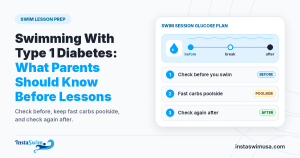
Yes, most children with type 1 diabetes can swim and take lessons. Swimming is exercise, so blood sugar can drop during and after it. Plan with the diabetes care team, check glucose before and after, keep fast carbs poolside, and tell the instructor what a low looks like.
Can kids with type 1 diabetes swim?
For most families the answer is yes. The American Diabetes Association's exercise guidance for type 1 diabetes is about how to plan for activity, not whether to avoid it. Swimming is a skill your child will use for life, and type 1 diabetes is not rare in children: the CDC counts about 314,000 children and teens under 20 in the U.S. living with type 1 diabetes, and a CDC funded study found the rate in young people rose from 148 to 215 per 100,000 between 2001 and 2017.
What changes is the planning. Diabetes does not make a child a weaker swimmer. It adds one more thing to watch: blood sugar, during the lesson and for hours afterward. The rest of this guide is about building that watch into a routine so the lesson itself can be about kicking, floating and having fun.
One important framing: a family and its diabetes care team decide whether and how a child takes part in swimming. Nothing here replaces that conversation, and this guide is not medical advice.
Why the pool can move blood sugar
Swimming is exercise. Muscles use glucose when they work, so blood sugar often falls during activity. The CDC lists "the amount and timing of physical activity" as one of the causes of low blood sugar, and the ADA advises checking glucose before, during and after exercise to learn how each activity affects you.
The drop can come later. An international consensus statement on exercise in type 1 diabetes, published in The Lancet Diabetes and Endocrinology in 2017, notes the greatest risk of overnight lows follows afternoon activity. An after school swim lesson fits that pattern, so the plan does not end when your child climbs out of the pool.
Water itself is not well studied. Researchers at the Children's Diabetes Centre in Perth noted in 2020 that indirect evidence suggests being in cool or warm water may speed up the fall in blood glucose, but that this had never been directly tested. In practice, that is one more reason to check more often around swimming than around dry land play until you know your child's pattern.
Lows are harder to spot in water. The CDC lists shaking, sweating, dizziness, hunger, a fast heartbeat, nervousness, irritability and confusion as common symptoms. In a pool, sweat is invisible, shivering can look like being cold, and a tired or cranky child can look like a child who simply wants to be done. That is why the instructor needs to know your child's own signs, and why someone on the pool deck should be watching for them.
Can look like a normal lesson
- Shivering or teeth chattering
- Wanting to stop or rest
- Grumpy or teary
- Asking for a snack
Worth a glucose check
- Shaky hands on the wall
- Suddenly confused by easy instructions
- Dizzy, pale or unusually quiet
- Any sign your child usually shows before a low
Pumps, CGMs and water: what the makers say
Device ratings vary a lot by model, and they change as new versions come out. The table below lists what each maker's own page said when this guide was written. Always check the manual for the exact model your child wears.
| Device | Maker's water rating | What it means at a lesson |
|---|---|---|
| Dexcom G7 sensor | Waterproof to 2.4 m (about 8 ft) for up to 24 hours | Fine to wear in the pool. Keep any receiver dry. |
| FreeStyle Libre 3 Plus sensor | Water resistant to 1 m (3 ft); do not immerse longer than 30 minutes | Ask the care team about deep water or lessons longer than 30 minutes. |
| Omnipod 5 Pod | IP28, up to 25 ft for 60 minutes | Pod can stay on. The Controller is not waterproof, so it stays dry. |
| t:slim X2 pump | IPX7, tested to 3 ft for 30 minutes; listed as not waterproof | Not meant for swimming. Ask the care team how to handle time disconnected. |
Readings may pause underwater. Dexcom notes that you may not receive real time readings or alerts while your device is out of range or underwater, and that data is sent once the device is back in range. A CGM is still useful at the pool, but the phone on the deck may not show a live number while your child is in the water. Plan a quick look at the screen during breaks instead of counting on alarms.
Phones and controllers stay dry. Keep the phone, receiver or pump controller in a bag at the edge of the pool, close enough to stay in range. A zip bag or towel works.
Sunscreen and pods. Omnipod warns that solvents in sunscreen and bug spray may cause cracks in the Pod casing. For outdoor lessons, apply sunscreen with your hands and keep it off the device.
Disconnected pump means no insulin. If the pump comes off for the lesson, insulin delivery stops while it is off. How long that can safely be, and whether to adjust anything before or after, is a question for your child's care team, not for the pool deck.
Before the first lesson: questions for the diabetes care team
A short message or appointment before lessons start saves a lot of guessing. These are good questions to bring:
- What range should my child be in before getting in the pool? The 2017 exercise consensus statement suggests 7 to 10 mmol/L (about 126 to 180 mg/dL) as a reasonable starting range for most people doing aerobic exercise up to an hour, and to wait until glucose is above 5 mmol/L (90 mg/dL). Your team may set a different range for your child, especially for toddlers.
- Do we need a snack before, and how much? The ADA suggests a small carb snack when glucose is under 100 mg/dL before activity. Ask what fits your child's size and insulin plan.
- What do we do with the pump or pod? Keep it on, take it off, or change a setting. Ask about time limits for being disconnected.
- What if glucose is high before the lesson? The ADA says to check for ketones when glucose is high and to avoid vigorous activity if ketones are present. Ask for your child's exact cutoffs.
- How much fast acting carb treats a low for my child? The CDC notes young children may need less than 15 grams, especially infants and toddlers.
- What about tonight? Ask whether to check more often overnight after a late afternoon lesson.
- Can you update the written plan? If your child already has a school Diabetes Medical Management Plan, ask whether swimming should be added to it so everyone works from the same instructions.
What to tell the swim instructor
A swim instructor teaches swimming. They are not your child's diabetes manager, and you should not expect them to be. What they can do is teach in a way that fits your child's plan, and that starts with telling them what matters.
On InstaSwim, the booking form asks about health conditions and special needs so the instructor knows beforehand, and the specifics are shared directly between your family and the instructor. Instructors on the platform are independent contractors who describe their own experience on their profiles, so it is fair to ask whether they have taught a child with type 1 diabetes before and how they like to handle breaks.
Keep the handoff short and practical:
- The basics. "My child has type 1 diabetes. I will check before and after, and I will be on the deck the whole time."
- Their signs. The two or three things your child does before a low, in their own words if they can say it ("my legs feel wobbly").
- The stop signal. Agree that if your child says they feel low, or you wave, the instructor brings them to the wall and out of the water right away, no questions.
- Breaks. Ask for a short check at the midpoint of longer lessons. Our guide to how long a swim lesson should be can help you pick a length that fits your child's routine.
- The device. Point out the sensor or pod so the instructor avoids grabbing or bumping it during holds.
- The kit. Show where the fast carbs, meter and any glucagon are, and who uses them. Usually that is you.
For lessons with minors on InstaSwim, a parent or guardian stays present, which fits a diabetes plan well: the person who knows the plan best is right there. If you are not sure how close to sit, our guide on whether parents should watch swim lessons covers how to watch without distracting your swimmer.
A swimming with type 1 diabetes plan for lesson day
Once the care team has given you numbers, lesson day becomes a routine. Here is a simple shape to fill in with your own plan.
Before: check and decide
Check glucose shortly before the lesson, at the time your plan says. Compare it to the range your care team gave you. Snack, wait, or check ketones as the plan directs. Do not start a lesson while low.
Poolside: set up the kit
Fast acting carbs, the meter or CGM phone, the pump controller, water, a towel and any glucagon, all in one bag at the edge of the pool. The ADA advises always carrying a carb food or drink, like juice or glucose tabs.
During: watch and check at breaks
Watch your child, not your phone. Glance at the CGM during breaks, since readings may pause while the sensor is underwater. Use the stop signal if anything looks off.
After: check and refuel
Check again once your child is out and dried off. Reconnect the pump if it came off. Many families keep a snack in the car for the ride home.
Tonight: remember the lesson
Afternoon activity carries the highest risk of overnight lows, according to the 2017 consensus statement. Follow your care team's advice on extra checks or alarm settings.
Keep a simple log for the first few weeks. Write down the glucose before, the snack, the lesson length, the glucose after and anything overnight. After a few lessons a pattern often shows up, and your care team can fine tune the plan from real numbers.
If you are still picking a place to swim, warmer indoor pools and home pools let you control the setting. Our guide on how to find a pool for swim lessons walks through the options. For budgeting, the swim lesson cost guide covers typical private lesson prices.
If blood sugar drops during a lesson
Agree on these steps before the first lesson so nobody improvises in the moment. Your child's written plan comes first; this is the general shape from the CDC.
- Out of the water first. Bring your child to the wall and out of the pool. Treating a low while someone is swimming or treading water is not a plan.
- Check. Confirm with a meter or CGM if you can. If you cannot check right away and your child has symptoms, the plan usually says to treat.
- Treat with fast carbs. The CDC's 15-15 rule: have 15 grams of carbs, wait 15 minutes, recheck, and repeat if still below 70 mg/dL. Examples include 4 ounces of juice or regular soda, or glucose tablets as directed. Young children may need less.
- Refuel, then decide. Once back in range, the CDC suggests a snack or meal with protein and carbs. Whether to go back in the water that day is your call, guided by the plan. Many families end the lesson there.
Severe lows are an emergency. The CDC says blood sugar below 55 mg/dL is severely low and that injectable glucagon is the best way to treat it. If your child cannot safely swallow, is not responding, or has a seizure, follow the emergency steps in the plan, use glucagon if prescribed, and get emergency medical help right away. Make sure the adult on the pool deck knows where the glucagon is and how to use it.
Swim lessons are one layer of water safety, not a substitute for supervision, barriers and a watchful adult. Our drowning statistics report explains why every layer matters, and families planning around another condition that can affect awareness in the water may find our guide to swimming with epilepsy useful too.
Adults with type 1 learning to swim
Plenty of adults with type 1 diabetes never learned to swim, and it is never too late. The same steps apply: talk with your care team, check before and after, keep fast carbs at the edge of the pool, and tell your instructor what a low looks like for you and what you want them to do if you signal one.
The 2017 consensus statement advises avoiding exercise in particularly unsafe settings, giving swimming alone as an example. As a beginner you will be with an instructor, which helps, but the same rule holds after lessons end: swim where someone knows your plan and can see you.
Fall and winter are a good time to start. Indoor pools keep lessons going all year, and adult bookings on InstaSwim stay strong through the colder months while kids lessons slow down.
Frequently asked questions
Can kids with type 1 diabetes take swim lessons?
Yes, most can. Swimming is exercise, so blood sugar can drop during and after a lesson. Families plan with their diabetes care team, check glucose before and after, keep fast acting carbs poolside, and tell the instructor what a low looks like for their child.
Can you swim with an insulin pump?
It depends on the pump. Some tubeless pods are rated for swimming, such as the Omnipod 5 Pod at up to 25 feet for 60 minutes, while others, like the t:slim X2, are not meant for swimming and are usually disconnected. Ask the care team how long your child's pump can be off.
Can you swim with a CGM?
Many CGM sensors can be worn in the pool, but ratings differ. Dexcom says the G7 is waterproof to 2.4 meters for 24 hours, while Abbott rates the FreeStyle Libre 3 Plus to 1 meter for no longer than 30 minutes. Readings may not come through while the sensor is underwater.
Does swimming lower blood sugar?
It often does, because swimming is exercise and working muscles use glucose. Lows can also happen hours later, and a 2017 consensus statement notes overnight lows are most likely after afternoon activity. Checking before, during breaks and after helps you learn your child's pattern.
Should a child with type 1 diabetes eat before swimming?
Sometimes. The American Diabetes Association suggests a small carb snack if glucose is under 100 mg/dL before activity. The right snack and amount depend on your child's insulin plan, so ask the diabetes care team for numbers that fit your child.
What should I tell a swim instructor about my child's diabetes?
Tell them your child has type 1 diabetes, the signs your child shows before a low, and that if your child says they feel low the instructor should bring them out of the water right away. Show where the fast carbs and supplies are, and point out the sensor or pod so it is not bumped.
Ready to plan your first lesson?
Browse independent instructors near you, read their self described experience, and choose the one who fits your family and your child's plan.
Find Instructors Near YouSources
- CDC, National Diabetes Statistics Report. 314,000 children and adolescents under 20 with type 1 diabetes.
- American Diabetes Association, Statistics About Diabetes. Type 1 figures from the CDC report, 2023 data.
- CDC, press release on youth diabetes (2021). Type 1 rate in youth rose from 148 to 215 per 100,000, 2001 to 2017.
- CDC, Low Blood Sugar (Hypoglycemia). Symptoms and causes, including physical activity.
- CDC, Treatment of Low Blood Sugar. Under 70 mg/dL, the 15-15 rule, smaller amounts for young children, severe lows under 55 mg/dL and glucagon.
- American Diabetes Association, Exercise and Type 1. Checking before, during and after, snacks under 100 mg/dL, ketones, carrying carbs.
- Riddell and colleagues, Exercise management in type 1 diabetes: a consensus statement, The Lancet Diabetes and Endocrinology (2017), accepted manuscript. Starting range, overnight lows after afternoon activity, swimming alone.
- American Diabetes Association, Safe at School. Diabetes Medical Management Plan.
- Dexcom, Can I get my Dexcom sensor wet? (UK FAQ). G7 water rating, receiver kept dry, readings underwater.
- Abbott, FreeStyle Libre 3 Plus sensor water resistance. 1 m for up to 30 minutes.
- Omnipod, Summer tips for protecting your Omnipod. Pod IP28 rating, Controller not waterproof, sunscreen caution.
- ADCES danatech, t:slim X2 with Control-IQ product detail. IPX7 rating, not for swimming.
- Children's Diabetes Centre, Telethon Kids Institute, water immersion study (2020). Effect of water on blood glucose not yet directly tested.
About this guide
Compiled by the InstaSwim team in October 2026 from CDC and American Diabetes Association pages, a 2017 international consensus statement on exercise in type 1 diabetes, and device makers' own water ratings. Device ratings vary by model and change over time, so check your own device's manual. Glucose ranges and carb amounts here are general figures from those sources; your child's care team may set different ones. Instructors on the InstaSwim platform are independent contractors who describe their own methods and experience, and families decide with their care team whether and how a child takes part. Swim lessons are one layer of protection and never make anyone drown proof. This guide is general information and is not medical advice.