When to Stop Swim Lessons: How to Know Your Child Is Ready
Your child swims across the pool, jumps in with a grin and asks why they still need lessons. It is a fair question, and figuring out when to stop swim lessons is one of the most common decisions parents face after the first few seasons. Lessons cost time and money, and at some point the weekly routine has done its job.
This guide gives you a clear finish line that does not depend on age or a level badge: five skills your child can show you in deep water. It also covers how the water your child actually uses changes the answer, signs to keep going, and how to wind down lessons without losing what they learned.
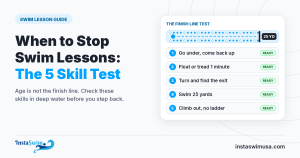
Stop when your child can do all five basic water competency skills, on any day, in the kind of water they actually swim in. Age is not the test. The American Red Cross skills are: go under over their head and come back up, float or tread for a minute, turn around to find the exit, swim 25 yards, and get out without a ladder. Adults still watch every swim.
Why age is not the finish line
Many families stop lessons at a natural break: the end of summer, a busy school year, a new sport. That is understandable, but the timing often lands before the skills are solid. Royal Life Saving Society Australia reported in October 2024 that more than 40% of children leaving primary school had not reached that country's national swimming and water safety benchmarks for 12 year olds, and that many children drop out of swim programs between the ages of 8 and 10.
Parents are also not always the best judges of their own child's swimming. In research described by Life Saving Victoria in March 2026, children ages 10 to 12 were tested in a pool. Of the children whose parents rated them okay swimmers, 65% could not swim 50 meters. Of those rated good, 38% could not. Even among children rated excellent, 21% could not.
Those figures come from Australia, which tracks this more closely than the United States does. The US picture points the same way: a CDC survey published in 2024 found that about 54.7% of US adults had never taken a swimming lesson and 15.4% reported not knowing how to swim. Plenty of people stop learning long before they are water competent.
The takeaway: a birthday, a level name or a summer ending is a scheduling milestone, not a skills milestone. Use a skills test instead.
The five skill test for when to stop swim lessons
The American Red Cross describes water competency as a combination of safety awareness, physical skills and the ability to respond to an emergency. Its five basic skills are a practical checklist for parents, because each one matches something that happens in a real fall into the water.
| Skill | Why it matters | What to watch for |
|---|---|---|
| 1. Enter water over their head and return to the surface | An accidental fall can put a child in over their head without warning | Comes up calmly, without grabbing the wall right away |
| 2. Float or tread water for at least 1 minute | Buys time to breathe, rest and call for help | Relaxed body, face clear of the water, no frantic splashing |
| 3. Turn around in a full circle and find the exit | A child who surfaces facing the wrong way needs to reorient | Turns on purpose and heads for the nearest edge or steps |
| 4. Swim at least 25 yards to an exit | That is about one standard pool length | Keeps going without stopping, standing or reaching for a noodle |
| 5. Exit the water without a ladder | Many pool edges, docks and boats have no steps | Pulls up and out over the side on their own |
A fair test happens in water over your child's head, with no vest, noodle or float of any kind, and with the instructor in the water. Ask to see the five skills done in a row, the way they would happen in a real emergency, rather than one at a time with breaks. Then ask to see it again on a different day. One good attempt is not the same as a skill your child can count on.
- Test the sequence, not just the parts. Going under, coming up, turning, swimming and climbing out back to back is much harder than each skill alone.
- Watch the face, not just the body. A child who looks calm is in a very different place from one who finishes in a panic.
- Ask the instructor what they see. Instructors on the InstaSwim platform are independent contractors who describe their own methods on their profiles, so ask yours how they check each skill and what they would want to see before you step back.
Match the skills to the water your child uses
The five Red Cross skills are a floor, not a ceiling. A child who only swims in a calm backyard pool needs less than a child heading to summer camp at a lake or a family trip to the ocean. Australia's national benchmark for 12 year olds asks for more, including swimming continuously for 50 meters, floating, sculling or treading for 2 minutes and signaling for help, and performing a survival sequence while wearing light clothing.
Mostly pools
- All five Red Cross skills, done in a row
- Comfortable in the deep end, not just the shallow end
- Can get out over the edge where there is no ladder
- Knows the pool rules and asks before swimming
Lakes, oceans and camps
- Longer swims and longer floats than the pool minimum
- Practice in clothes, since a fall can happen in everyday clothes
- Understands that open water is colder, darker and moving
- Wears a life jacket for boating and open water play
If a big change is coming, such as a first season at camp, a beach vacation or a teen looking at a pool job, that is often a good reason to add a short block of lessons aimed at that setting rather than to stop.
Signs to keep going (or change things up)
Keep lessons going if any of these sound familiar. None of them mean your child is behind; they just mean the skills are not reliable yet.
- They need the wall, a noodle or a vest to get through any of the five skills.
- They only swim in the shallow end or stand up partway across the pool.
- They tire or stop before 25 yards, or their stroke falls apart when they are tired.
- They panic when their face goes under or when they cannot touch the bottom.
- The skills come and go. They float beautifully one week and sink the next.
- New water is on the calendar, like a lake, an ocean trip or a camp swim test.
Slow progress is a reason to talk, not to quit. Ask the instructor what is getting in the way and what the next few lessons will focus on. Sometimes a shorter or longer session helps; our guide to how long a swim lesson should be covers what tends to work by age. If the fit is not right, you can review other independent instructors' self described experience and choose someone new.
Signs your child is ready to step back
When the skills are there, you have permission to scale back. These are good signs that weekly lessons have done their job:
- All five skills, in a row, on more than one day, in water over their head with no flotation.
- They are calm in deep water and can rest by floating or treading when they get tired.
- The skills hold up after a break, such as a few weeks away during the school year.
- They have met the goal you set together, whether that was water safety, a swim test or a stroke.
- They are ready for something new, like a swim team, stroke clinics or simply swimming for fun with family.
Stepping back does not have to mean stopping cold. Many families switch from weekly lessons to a few refresher sessions before swim season, which is a simple way to check the skills after months away from the water. For ideas on staying sharp between seasons, see our guide to maintaining skills during the off season.
What stopping lessons does not change
Swim lessons are one layer of protection. They are never a reason to stop watching, and no child is drown proof. In its updated drowning prevention policy statement published in 2026, the American Academy of Pediatrics stressed multiple layers of prevention, including close, constant, attentive and capable adult supervision, and noted that adolescents may overestimate their swimming skills.
Supervision
An adult who can swim watches every swim without phones or distractions. For weak swimmers and young children, the AAP advises staying within arm's length.
Barriers
Fences, gates and alarms around home pools still matter after lessons end. Our backyard pool safety checklist walks through each one.
Life jackets in open water
Strong pool swimmers still wear a life jacket for boating and in lakes, rivers and oceans.
Adults who know CPR
The American Red Cross says bystander CPR can double or triple a drowning victim's chance of survival.
Older kids need this as much as toddlers. CDC data show drowning is the leading cause of death for children ages 1 to 4 and the second leading cause of unintentional injury death for children ages 5 to 14. For the full picture, see our drowning statistics report and our tips on water safety for teens.
About the research: a 2009 case control study found formal swim lessons were associated with an 88% lower drowning risk for children ages 1 to 4. For ages 5 to 19, the study found a 64% lower risk that was not statistically significant. Lessons help, but the evidence is one more reason to keep every other layer in place for older kids too.
A simple plan to wind down private lessons
If you are using private lessons, a short, planned finish works better than simply cancelling the next booking.
Name the goal with the instructor
Tell them you want to finish with the five water competency skills, plus anything your family needs for camp, the beach or a swim team.
Run the five skill test
In deep water, no flotation, all five in a row. Note anything that is shaky.
Fix the weak spot
Use the next few lessons on whatever wobbled, often treading water or the climb out without a ladder.
Test again on a different day
If it holds, you have a skill your child can rely on, not a good day.
Book a refresher before next swim season
A session or two in spring is an easy check after months away from the pool.
As a rough planning range from our other guides, many children need about 6 to 12 private lessons to build basic water safety skills and about 12 to 20 to swim confidently on their own, though every child is different. Because InstaSwim pricing is per lesson, a refresher costs the same as any other lesson; see our swim lesson cost guide for current prices.
Frequently asked questions
What age do most kids stop swim lessons?
There is no official age. Water safety groups in Australia report that many children leave lessons between about 8 and 10, often before they reach the swimming benchmarks set for 12 year olds. A better marker than age is whether your child can do all five basic water competency skills in deep water, without a flotation aid, on any given day.
Is it okay to stop swim lessons once my child can swim?
It depends on what can swim means. Paddling across the shallow end is not the same as getting back to the surface after falling in over their head, floating or treading for a minute, turning to find the exit, swimming 25 yards and climbing out without a ladder. If your child can do all five in the kind of water they actually use, stepping back from weekly lessons is a reasonable call.
How do I know if my child is a strong enough swimmer?
Ask the instructor to run the five American Red Cross water competency skills in water over your child's head, with no noodle or vest, and watch. Look for calm, repeatable skills rather than one lucky try. If your child tires before 25 yards, panics when going under, or only manages in the shallow end, keep going.
Does my child need swim lessons year round?
Not necessarily. Many families switch from weekly lessons to a few refresher sessions before swim season once the core skills are solid. A refresher is a simple way to check that floating, treading and the 25 yard swim still hold up after months away from the water.
Can I stop swim lessons if my child hates them?
Before you stop, talk with the instructor about what is going wrong. Fear, cold water, the time of day or simply a poor fit can all play a part, and a slower pace or a different instructor often helps. If a child's fear is severe or affects daily life, talk with your pediatrician or a mental health professional.
Do teenagers still need swim lessons?
Some do. The American Academy of Pediatrics notes that adolescents may overestimate their swimming skills, and CDC data show drowning is the second leading cause of unintentional injury death for children ages 5 to 14. A teen who cannot do the five basic skills, or who is heading to lakes, oceans or a pool job, can benefit from more lessons at any age.
Finish strong with the right instructor
Browse independent swim instructors near you, read their self described experience, and choose who fits your family for a final block of lessons or a spring refresher.
Find Instructors Near YouSources
- American Red Cross, Water Competency (2026). Definition of water competency, the five lifesaving swim elements, and the bystander CPR statement.
- American Red Cross, Water Safety Skills infographic (2020 survey). Wording of the five basic water safety skills, including exiting a pool without the ladder.
- American Academy of Pediatrics, HealthyChildren.org, AAP releases updated drowning prevention recommendations (2026). Layers of prevention, arm's length supervision, and adolescents overestimating their skills.
- Archives of Pediatrics and Adolescent Medicine, Association Between Swimming Lessons and Childhood Drowning (2009). 88% lower risk for ages 1 to 4; 64% for ages 5 to 19, not statistically significant.
- CDC, MMWR Vital Signs: Drowning Death Rates, Self Reported Swimming Skill and Swimming Lesson Participation (2024). 54.7% of US adults never took a lesson; 15.4% cannot swim.
- CDC, Drowning Data. Leading cause of death for ages 1 to 4; second leading cause of unintentional injury death for ages 5 to 14.
- Royal Life Saving Society Australia, National Swimming and Water Safety Benchmark, age 12. 50 meter swim, 2 minute float or tread, survival sequence in light clothing.
- Royal Life Saving Society Australia, 40% of Children Are Missing Water Safety Benchmarks (2024). Share of children leaving primary school below the benchmark and dropout between ages 8 and 10.
- Life Saving Victoria, Children Stop Swimming Lessons Too Early, Creating Water Safety Risk (2026). Parent ratings versus tested 50 meter swims for children ages 10 to 12.
- Stallman, Moran, Quan and Langendorfer, From Swimming Skill to Water Competence, International Journal of Aquatic Research and Education (2017). Why water competence is a broader goal than swimming skill alone.
About this guide
Compiled by the InstaSwim team in October 2026 from the American Red Cross, the American Academy of Pediatrics, the CDC, a peer reviewed case control study, and Australian water safety bodies (Royal Life Saving Society Australia and Life Saving Victoria). Australian figures describe Australian children and are used because comparable US data is limited. Lesson counts are planning estimates, not targets. Instructors on the InstaSwim platform are independent contractors who describe their own methods and experience; families decide when lessons have met their goals. Swim lessons are one layer of protection, and no child is drown proof. This guide is general information and is not medical advice.