Swimming With Scoliosis: What Parents Should Know
If your child was just told they have a curve in their spine, swimming with scoliosis is probably one of the first things you wonder about. Can they still do lessons, swim team or a pool day with friends? Does the brace come off? Will swimming help the curve, or could it make it worse?
This guide pulls together what orthopedic and children's hospital sources say about scoliosis and swimming: what the water can and cannot do for a curve, how swimming fits around a brace schedule, what the research says about getting back in the pool after spinal fusion surgery, and how to plan swim lessons that work for your child.
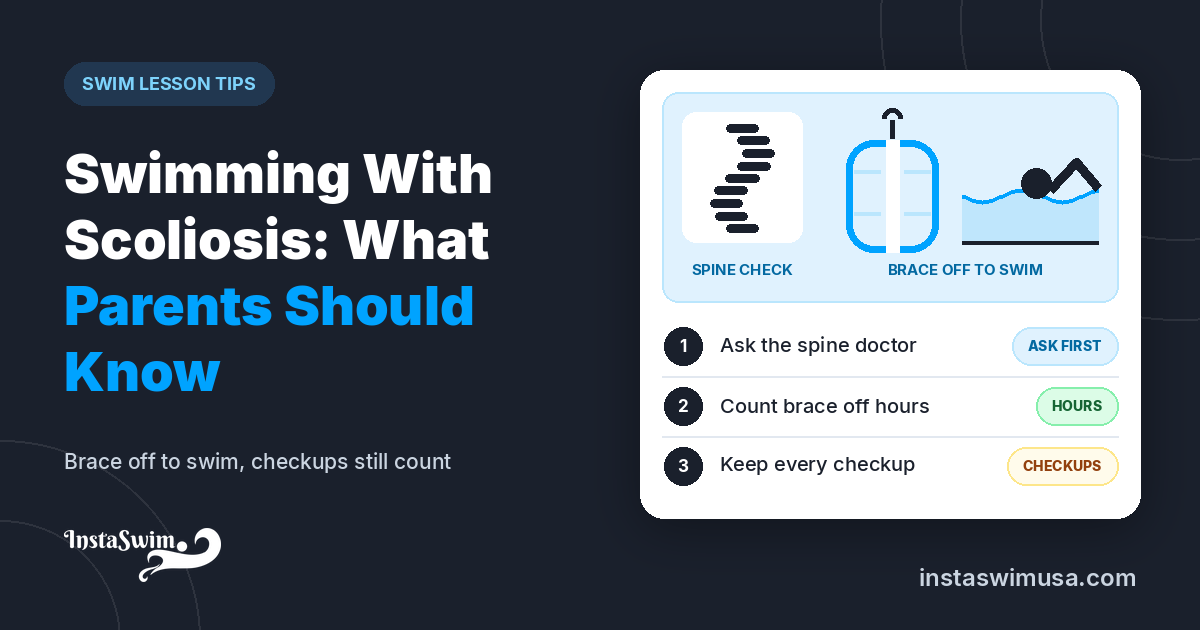
Most children and teens with scoliosis can swim. Spine specialists generally let kids take their brace off for swimming and sports, and there is no evidence that recreational swimming makes a curve worse. Swimming is not a treatment, though: it does not straighten a curve or replace bracing or checkups. Ask your child's spine doctor first, especially after surgery.
Can kids with scoliosis swim?
For most families the answer is yes. Scoliosis is a sideways curve of the spine, and the most common type in children, idiopathic scoliosis, has no single known cause. The American Academy of Orthopaedic Surgeons (AAOS) says it is not caused by things like carrying a heavy backpack or having poor posture, and most cases show up between about age 10 and the end of growth. Both boys and girls can have it, but girls are more likely to develop larger curves that need treatment.
The National Scoliosis Foundation puts the activity question plainly: most people with scoliosis are completely normal in their ability to take part in sports, and no information suggests that recreational exercise and sports make curves worse. It says children and teens with scoliosis can be expected to join organized sports, school PE and everyday neighborhood play. The NHS says children with scoliosis can usually do most types of exercise and only need to avoid certain activities if a specialist advises it.
There are exceptions, and your child's spine doctor is the one who decides them. The National Scoliosis Foundation notes that some limits may apply for very severe curves that affect breathing, or after spinal surgery. The National Institute of Arthritis and Musculoskeletal and Skin Diseases (NIAMS) simply advises families to talk to the child's doctor about sports and activities.
| Curve and stage | Usual plan (AAOS) | What it means for swimming |
|---|---|---|
| Mild curve, under about 20 to 25 degrees | Watch it with rechecks every 6 to 12 months | Usually no change to normal swimming |
| Moderate curve in a growing child, about 20 to 45 degrees | Brace worn many hours a day until growth is done | Brace comes off for swimming; plan pool time inside the allowed hours |
| Larger curve, over about 45 to 50 degrees | Surgery is often recommended | A pause, then a gradual return the surgeon clears |
The AAOS pages give slightly different cutoffs (one says bracing for 25 to 45 degrees, another for 20 to 40), so treat these as rough ranges. Your child's doctor will explain where their curve sits.
Does swimming help or hurt the curve?
You will find plenty of websites calling swimming the best exercise for scoliosis. The research is more careful than that.
Swimming does not correct a curve. AAOS says there is no high quality evidence that physical therapy or exercise alone stops a curve from getting worse during growth, though some low quality studies suggest scoliosis specific exercises may help. NIAMS says exercise programs have not been well studied but may keep scoliosis from getting worse. The National Scoliosis Foundation adds that bracing alone has been found to work as well as bracing plus exercise, and that curve monitoring stays essential whatever exercise a child does.
One study looked at young competitive swimmers. In a 2015 study in The Journal of Pediatrics, researchers in Italy compared 112 adolescent competitive swimmers with 217 students of the same age (average age 12.5). The swimmers had higher odds of trunk asymmetry (an odds ratio of 1.86), of a rounded upper back called hyperkyphosis (2.26) and of a deeper lower back curve called hyperlordosis (2.24), and female swimmers had about twice the odds of low back pain. The authors wrote that these results contradict the idea of swimming as a treatment for scoliosis.
That study measured kids training competitively, not children taking lessons or swimming for fun, and a snapshot like this cannot show that swimming caused any of the differences. It is a good reason not to use swimming as a substitute for treatment, and to tell the doctor if your child swims on a team with long training hours.
What swimming can do
- Keep a child active and fit while a curve is being watched or braced
- Build water safety skills that matter for life
- Give a brace wearing teen a normal activity with friends
- Fit into recovery once the surgeon clears it
What swimming cannot do
- Straighten or reverse a scoliosis curve
- Replace a brace, surgery or regular X ray checkups
- Count as treatment on its own
- Tell you whether a curve is changing
If your child also gets back pain, our guide to swimming with back pain covers easing into laps. AAOS notes that physical therapy and home exercise can be very helpful for back pain even though they do not change the curve.
Swimming with scoliosis and a brace
Braces stay on land. The NHS says a brace normally only needs to come off for baths, showers, swimming and contact sports. The Scottish National Spine Service (NHS Lothian) recommends taking the brace off for exercise, sport, PE and swimming, and says it is best to keep exercising during brace treatment. AAOS says that as long as the doctor approves, the brace can come off for sports and other recreation.
The catch is the clock. Bracing works best when the brace is worn the full number of hours the doctor sets, and NIAMS says braces work well when a child is still growing and wears the brace as directed. Children's Hospital Colorado explains the trade off with these bands:
| Daily brace wear | What Children's Hospital Colorado says |
|---|---|
| Less than 12 hours | No benefit |
| 12 to 16 hours | Potential to stop the curve from getting bigger |
| 16 to 23 hours | Maximum benefit |
AAOS gives a similar picture: the most common daytime braces are worn 16 to 23 hours a day, and wearing a brace just 6 hours a day is nearly useless. Every child's prescription is different, so ask the brace team how many hours a day your child can be out of the brace, then plan pool time inside that window.
- Count swim time as brace off time. A lesson plus changing time adds up quickly. Add it up across the day with showers and sports.
- Pick a lesson time that fits the routine. A slot right after school, before the brace goes back on for the evening, can be easier than squeezing a lesson in mid day.
- Get the brace back on promptly. Have a towel and dry clothes ready so the brace goes on soon after the swim, the way the brace team advises.
- Ask about skin care. If the brace rubs after swimming or your child notices sore spots, mention it to the brace team rather than skipping wear.
- Plan for privacy. Some teens feel self conscious about a brace at the pool. A quiet place to change can make lessons easier to keep up.
Swimming after spinal fusion surgery
Spinal fusion is the operation the NHS describes for teenagers and young adults with a large curve. It says most young people spend about a week in hospital, go back to school after a few weeks and can play sports after a few months, though contact sports may need to wait longer. Some need a brace afterward.
Research gives a sense of the range. In a 2022 study in Spine Deformity, 112 teens who had posterior spinal fusion for idiopathic scoliosis were cleared by their surgeon for athletic activity beginning at 3 months, as long as they were pain free and their X rays were stable. Of the 76 who went back to sport at their old level or higher (67.8%), 12 returned at 3 months, 28 between 3 and 6 months and 36 after more than 6 months. Younger teens and smaller curves were linked with a quicker return. About a third did not return at the same level, most often because of stiffness or because a parent or pediatrician suggested holding off. No complications related to returning to sport were recorded.
A 2021 review of six studies in the same journal found that the time to return to sport ranged from 6 to 18 months across authors, and that 28% to 36.6% of patients changed sports, mostly to lower impact activities, because the fused spine is less flexible. It concluded that patients can safely return to any sport, even ones with a lot of spinal movement.
Wait for the incision to heal
No pool until the surgical wound is fully closed and the surgeon says so. Our guide to swimming with stitches covers pool time and healing wounds.
Get the surgeon's clearance in writing
Ask exactly what is allowed: walking in the shallow end, easy kicking, full strokes, diving, flip turns, and when each is fine.
Start with easy, short sessions
Expect stiffness. Short lessons with rest give your teen a chance to see how the new spine feels in the water.
Build up as the surgeon allows
Longer swims, faster strokes and team training come later, on the surgeon's timeline rather than the calendar.
Every surgeon sets their own plan. The 3 month and 6 to 18 month figures above come from specific study groups, not a rule for your child. Follow your child's surgical team on when swimming, diving and competitive training can resume.
Planning swim lessons for a child with scoliosis
Scoliosis rarely changes how a child learns to swim, but a little planning helps lessons fit around braces, checkups and recovery. With private lessons at a home or community pool, you can choose times that work with the brace schedule. If you do not have a pool, our guide on how to find a pool for swim lessons walks through the options.
- Talk to the spine doctor first. Ask whether there are any limits on strokes, diving or training time, and how many brace off hours your child has.
- Share the basics with the instructor. The InstaSwim booking form asks about health and needs so the instructor knows beforehand, and the specifics are shared directly between your family and the instructor. Your family decides, with the doctor, whether your child is ready to take part.
- Choose an instructor who fits. Instructors on InstaSwim are independent contractors who describe their own experience on their profiles. Read profiles closely and ask whether they have taught children with scoliosis, braces or recent surgery, and how they would adjust a lesson if something feels uncomfortable.
- Agree on a stop rule. Your child should know they can stop and tell you or the instructor if anything hurts. New or worsening back pain is worth mentioning to the doctor.
- Stay at the pool. A parent or guardian stays present for lessons with minors on InstaSwim, which also lets you watch how your child is moving. See our tips on whether parents should watch swim lessons.
Whatever the spine is doing, lessons are one layer of protection around water, never a reason to relax supervision. Our drowning statistics report explains why barriers, supervision and swim skills all matter together. For budgeting, the swim lesson cost guide shows typical private lesson prices.
Signs to mention to your child's doctor
A swimsuit can make a child's back easier to see. AAOS lists these as common signs of scoliosis:
- Uneven shoulders, with one shoulder blade sticking out more than the other
- Ribs that stick out more on one side
- An uneven waistline
- One hip that sits higher than the other
None of these means your child has scoliosis, and only a doctor can tell. If you notice one, mention it at the next checkup rather than worrying at the pool. Scoliosis is often found during a school screening or a routine visit, and mild curves are more common than large ones.
Frequently asked questions
Is swimming good for scoliosis?
Swimming is a healthy activity for most children and teens with scoliosis, but it is not a treatment. AAOS says there is no high quality evidence that exercise alone stops a curve from getting worse, and a 2015 study found young competitive swimmers had more trunk asymmetry than non swimmers. Swim for fitness, fun and safety, and keep up bracing and checkups.
Can swimming make scoliosis worse?
The National Scoliosis Foundation says no information suggests recreational exercise and sports make scoliosis curves worse. A 2015 study of 112 adolescent competitive swimmers found higher odds of trunk asymmetry than in students who did not swim, but it could not show that swimming caused it. If your child trains on a swim team, mention it to the spine doctor.
Can you swim with a scoliosis brace?
The brace comes off for swimming. The NHS says a brace normally only needs to be removed for baths, showers, swimming and contact sports, and AAOS says it can come off for sports if the doctor approves. Count pool time as brace off time and ask the brace team how many hours a day your child can be out of it.
How long after spinal fusion can you swim?
It depends on the surgeon. The NHS says most young people can play sports after a few months. In one 2022 study, teens were cleared for athletic activity from 3 months if pain free with stable X rays, and a 2021 review found return to sport ranged from 6 to 18 months. The incision must be fully healed before any pool time.
What is the best exercise for scoliosis?
No single exercise has been shown to fix a curve. AAOS says some low quality studies suggest scoliosis specific exercises may help, and that physical therapy and home exercise can be very helpful for back pain. NIAMS says weight bearing exercise like walking, running or soccer helps keep bones strong. Ask your child's doctor which activities suit them.
Does swimming cause scoliosis?
There is no evidence that swimming causes idiopathic scoliosis, whose exact cause is unknown. AAOS says it is not caused by behaviors like poor posture or heavy backpacks, and genetics plays a role in some cases. The National Scoliosis Foundation says scoliosis is not a result of exercise, so normal physical activities can be enjoyed.
Find a swim instructor who fits your family
Browse independent instructors near you, read their self described profiles and choose the one who fits your child's schedule, brace hours and goals.
Find Instructors Near YouSources
- AAOS OrthoInfo, Idiopathic Scoliosis in Children and Adolescents. Causes, family history, signs, treatment ranges, brace off for sports.
- AAOS OrthoInfo, Nonsurgical Treatment Options for Scoliosis. Brace hours, exercise and physical therapy evidence.
- NIAMS, Scoliosis in Children and Teens: Diagnosis, Treatment, and Steps to Take. Bracing as directed, exercise, sports.
- NHS, Scoliosis treatment in children. Brace removal for swimming, exercise, recovery after surgery.
- NHS Lothian Scottish National Spine Service, Daily brace wear. Brace off for exercise, sport, PE and swimming.
- Children's Hospital Colorado, Idiopathic scoliosis. Brace wear hour bands, staying active.
- National Scoliosis Foundation, Exercise and adolescents with scoliosis. Sports participation, exercise and curves.
- Zaina F, et al. Swimming and spinal deformities: a cross sectional study. J Pediatr (2015). Competitive swimmers vs students.
- Ruffilli A, et al. Return to sport after posterior spinal fusion for adolescent idiopathic scoliosis. Spine Deformity (2022). Clearance at 3 months, return rates and timing.
- Resumption of sport after spinal fusion for adolescent idiopathic scoliosis: a review. Spine Deformity (2021). Return range 6 to 18 months, sport changes.
About this guide
Compiled by the InstaSwim team in November 2026 from AAOS, NIAMS, the NHS, NHS Lothian, Children's Hospital Colorado, the National Scoliosis Foundation and three peer reviewed studies. Curve ranges and return to sport timelines vary between sources and study groups and are shown as ranges; your child's own plan comes from their spine team. The 2015 swimmer study measured competitive swimmers at one point in time and cannot show cause. Instructors on the InstaSwim platform are independent contractors who describe their own methods and experience. Swim lessons are one layer of protection and never make a child drown proof. This guide is general information and is not medical advice.