Swim Lessons for Teens Who Never Learned: A Guide for Parents
If your teenager never learned to swim, swim lessons for teens can still get them there, and they are far from the only one. Some kids missed lessons because of a move, money, a busy family schedule, a scary moment at age five, or simply because nobody had a pool. By 13 or 15 it starts to feel too late, and the idea of splashing next to six year olds is a hard no.
This guide covers why the teen years are a good time to learn, which lesson formats tend to work for older beginners, what they learn first, roughly how many lessons it takes, and how to raise the subject without making your teen feel singled out.
It is not too late. Teens can follow detailed instructions and practice on purpose, which helps them learn. Private or teen only lessons avoid the embarrassment of a kids class, and many beginners reach basic water safety skills in roughly 8 to 12 lessons. Lessons are one layer of protection and never make anyone drown proof.
Your teen is not the only one who cannot swim
Not knowing how to swim is far more common than most teens assume. In a 2024 CDC report based on a national survey, 15.4% of U.S. adults said they did not know how to swim, and 54.7% said they had never taken a swimming lesson. That is almost 40 million adults who cannot swim, according to the CDC.
Kids are in the same position. In a 2014 American Red Cross survey, just four in ten parents of children ages 4 to 17 said their child could perform all five basic water safety skills. The same survey found that 80 percent of Americans said they could swim, but only 56 percent of those self described swimmers could do all five skills. In other words, plenty of people who think they can swim have gaps too.
Access is a big part of the story. The CDC notes that swimming lessons may be too expensive or not available in some communities, and its 2024 report found that lesson participation differed by age, sex, race and ethnicity. A teen who never learned did not fail at anything. They usually just never had a good chance.
Why the teen years matter for water safety
The American Academy of Pediatrics (AAP) says that while childhood drowning risk drops after age 4, it goes up again during the teen years, and that this is true even among strong swimmers. A few things change at this age:
- More time in open water. The AAP notes that teens are more likely to drown in lakes, rivers, oceans and ponds. CDC data show that almost half of fatal drownings among people 15 and older happen in natural water.
- More independence. Teens go to beaches, lakes, pool parties and camps with friends instead of parents, often without a lifeguard nearby.
- Overconfidence and peer pressure. The AAP says teens are more likely to overestimate their skills and underestimate dangerous situations, and that peer pressure can push teens to keep up with friends even without the skills.
- Alcohol enters the picture. The CDC reports that among adolescents and adults, alcohol use is involved in up to 70% of deaths associated with water recreation. It is worth talking about openly.
None of this is a reason to panic. It is a reason to see lessons now as one practical layer of protection, alongside supervision, life jackets and good judgment. The CDC states that formal swimming lessons can reduce the risk of drowning among children and young adults. For the bigger picture, see our drowning statistics report and our guide to water safety for teens.
Choosing swim lessons for teens: private, group or adult class
The right format is often the one your teen will actually show up for. Comfort matters more than usual at this age, because embarrassment can keep older beginners from starting or sticking with it. NPR reported on one program, First Strokes, that runs classes only for teenagers, taught by fellow teens, precisely because many teens would be embarrassed to learn next to little kids.
| Format | Who it suits | Things to weigh |
|---|---|---|
| Private lessons at a home or community pool | Teens who feel self conscious, are nervous in water, or have a tight schedule | One on one attention and no audience; costs more per lesson than a group class |
| Teen only group class | Teens who like learning with peers their own age | Social and lower cost; less common, so availability varies by area |
| Adult beginner class (where teens are allowed) | Older teens who would rather be with adults than kids | Age rules vary by program; pace may be set for adult learners |
| Kids group class by skill level | Younger teens who do not mind mixed ages | Often the cheapest; can be the most embarrassing for a teen |
Private lessons can suit a teen who has never learned, because the teen sets the pace and nobody is watching from the next lane. If you are weighing the cost, our swim lesson cost guide has current price ranges, and are private swim lessons worth it walks through the tradeoffs. With InstaSwim, pricing is per lesson rather than per student, so siblings who both need to learn can share a longer lesson.
What a teen beginner learns first
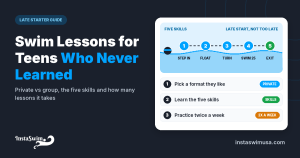
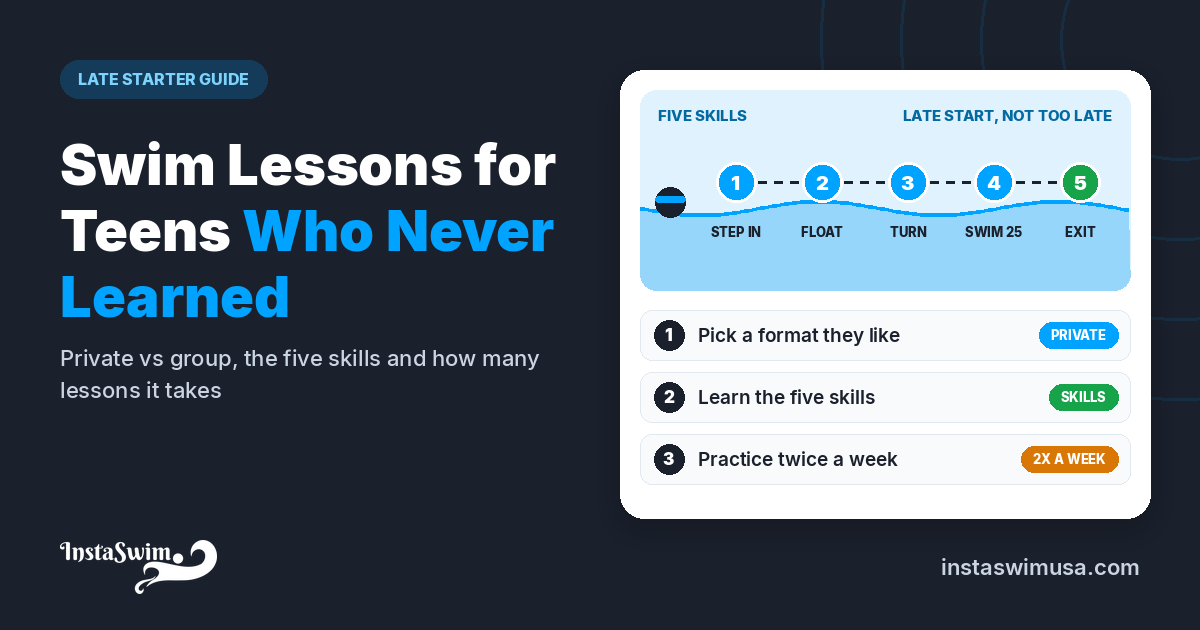
Good beginner lessons start with comfort and work toward what the Red Cross calls water competency. The Red Cross lists five basic skills that could save a life in the water. A clear goal like this also helps teens, because they can see exactly what they are working toward.
Step or jump into water over your head
Usually the last thing a nervous beginner tries, after lots of time in shallow water first.
Return to the surface and float or tread water for one minute
Floating on the back is often the turning point, because it shows the body will stay up with calm breathing.
Turn around in a full circle and find an exit
Builds the habit of orienting before swimming anywhere.
Swim 25 yards to the exit
Any stroke counts here. Form can come later.
Exit the water
The Red Cross adds that in a pool, you should be able to get out without using the ladder.
Before skill one, most beginners spend time on breath control: blowing bubbles, putting the face in, and learning that water in the nose is uncomfortable, not dangerous. If your teen is anxious rather than just inexperienced, our guide to overcoming fear of water was written for adults but works well for older teens too.
How many lessons a teen usually needs
Every learner is different, so treat these as planning estimates, not targets. Teens generally follow the same late starter path as adults, and they can follow multi step instructions and practice between lessons.
| Goal | Typical range | What it looks like |
|---|---|---|
| Comfort in the water | 2 to 4 lessons | Face in, bubbles, floating with support, relaxed in shallow water |
| Basic skills for a beginner | 8 to 12 lessons | Floats, treads briefly, swims short distances, gets out on their own |
| Confident independent swimming | 12 to 20 lessons | Longer distances, deep water comfort, a recognizable stroke |
Frequency is the biggest lever. Two lessons a week usually builds skills faster than one, because there is less time to forget between sessions. A teen who is very afraid of water may need more comfort lessons at the start, and that is normal. For more on timelines, see learning to swim as an adult, which covers the same late starter path.
How to bring it up without embarrassment
How you raise the subject can matter as much as which lessons you book. A few approaches that can help:
- Make it about a goal, not a gap. A beach trip, a summer job, a friend's lake house or a school trip gives lessons a reason that is not "you are behind."
- Let them choose the format. Offer private, teen only or adult options and let your teen pick. Control over the setup lowers resistance.
- Keep it private. Do not mention it to relatives or their friends unless your teen wants to share.
- Share the numbers. Knowing that more than half of U.S. adults have never had a swimming lesson can make it feel ordinary.
- Set a short trial. Agree to a small first block of lessons, then decide together whether to keep going.
- Learn alongside them if you cannot swim either. Many families have a parent who never learned. Booking lessons for both can turn it into a shared project.
Teens often care about who else is around. With InstaSwim, lessons happen at your home pool or a pool your family has access to, such as a community, HOA, apartment or gym pool. A parent or guardian stays present for lessons with anyone under 18, though some teens are more comfortable if that parent watches quietly from a chair rather than from the pool edge.
Questions to ask an instructor
Instructors on the InstaSwim platform are independent contractors who describe their own experience on their profiles. You are the one who decides who fits your teen. These questions can help:
- Have you taught teens or adults who were complete beginners? What does a first lesson look like?
- How do you work with a learner who is nervous or embarrassed?
- What water safety skills do you aim for first, and how will we know they are making progress?
- What CPR, first aid or swim instruction training do you list, and is it current?
- How often would you suggest lessons each week for a teen at this starting point?
If your teen has a health condition or special need, the InstaSwim booking form asks about it so the instructor knows beforehand, and the details are shared directly between your family and the instructor. Your family decides, with your teen's doctor where appropriate, whether swimming is a good fit.
Safety habits that still matter after lessons
Learning to swim lowers risk, but the AAP is clear that knowing how to swim does not drown proof kids of any age. Talk with your teen about the habits that protect even strong swimmers:
- Swim where a lifeguard is on duty whenever possible, especially in open water.
- Wear a life jacket on boats and paddleboards. The CDC notes that most people who drowned in boating deaths in 2021 were not wearing one.
- Skip alcohol around water. The CDC says it impairs balance, coordination and judgment.
- Know that open water is different. Cold, currents and depth can overwhelm skills learned in a pool.
- Learn CPR. The AAP recommends that caregivers and adolescents learn CPR and how to perform a safe rescue.
One layer, not the whole plan: swim lessons work best combined with supervision, life jackets, lifeguarded swimming areas and avoiding alcohol around water. No lesson program makes any swimmer safe in all conditions.
Frequently asked questions
Is 13 too old to learn to swim?
No. People learn to swim at every age, and teens can follow detailed instructions and practice on purpose, which helps. The AAP notes that many organizations offer swim lessons geared specifically toward teens and adults.
How long does it take a teenager to learn to swim?
As a planning estimate, many beginners reach basic skills in about 8 to 12 lessons and confident independent swimming in about 12 to 20. Two lessons a week usually speeds things up. A teen who is very nervous may need a few extra comfort lessons first.
Are private or group swim lessons better for teens?
It depends on the teen. Private lessons suit teens who feel self conscious or nervous, because there is no audience and the pace is theirs. Teen only group classes suit teens who like learning with peers. A kids class is usually the hardest sell for an older beginner.
Can a teenager take adult swim lessons?
Often, yes. Many programs combine teens and adults in beginner classes, though minimum ages vary, so check each program's rules. Private lessons have no class age mix at all, which many teens prefer.
Do parents have to stay during a teen's swim lesson?
It depends on the program. With InstaSwim, a parent or guardian stays present for lessons with anyone under 18. You can usually watch quietly from a distance so your teen does not feel observed.
Will swim lessons make my teen safe in open water?
Lessons help, but no lesson makes anyone drown proof. The AAP says drowning risk rises again in the teen years even among strong swimmers, and the CDC reports that almost half of fatal drownings among people 15 and older happen in natural water. Lifeguarded areas, life jackets and no alcohol still matter.
It is not too late to learn to swim
Browse independent swim instructors near you, read their self described experience, and choose who fits your teen and your schedule.
Find Instructors Near YouSources
- CDC, MMWR Vital Signs: Drowning Death Rates, Self-Reported Swimming Skill, Swimming Lesson Participation, and Recreational Water Exposure (2024). Share of adults who cannot swim (15.4%) or never took a lesson (54.7%); differences by group.
- CDC, Drowning Deaths Rise in the United States (2024). Almost 40 million adults cannot swim; cost and access as barriers to lessons.
- CDC, Risk Factors for Drowning (2026). Natural water share for ages 15 and older; alcohol among adolescents and adults; lessons and risk; life jackets in boating deaths.
- American Academy of Pediatrics, HealthyChildren.org: Water Safety for Teens (2026). Teen drowning risk, overconfidence, peer pressure, open water, lessons for teens and adults.
- American Academy of Pediatrics, AAP Releases Updated Drowning Prevention Recommendations (2026). Adolescents overestimating skills; CPR and safe rescue for caregivers and adolescents.
- American Red Cross, national water safety survey press release (2014). The five water competency skills and survey findings on adults and children.
- NPR, Many teens don't know how to swim. A grassroots organization is trying to change that (2023). Teen only classes and embarrassment as a barrier.
About this guide
Compiled by the InstaSwim team in November 2026 from CDC, American Academy of Pediatrics, American Red Cross and NPR sources listed above. Survey figures are from the years shown and are self reported. Lesson counts are planning estimates that vary with each learner, their comfort level and how often they practice. Instructors on the InstaSwim platform are independent contractors who describe their own methods and experience; families choose and evaluate instructors themselves. Swim lessons are one layer of protection and do not make anyone drown proof. This guide is general information and is not medical advice.