How to Become a Swim Instructor: Steps, Training and Pay
If you are a strong swimmer who likes working with people, you may be wondering how to become a swim instructor and whether it can turn into real part time or full time income. The path is shorter than most people expect, but it has a few clear checkpoints: a swim skills test, an instructor course, current CPR and first aid, and a decision about where and how you want to teach.
This guide walks through each step using the published course requirements from the American Red Cross, pay data from the U.S. Bureau of Labor Statistics, and plain information about what it means to teach private lessons as an independent contractor. It is written for new instructors, lifeguards thinking about teaching, and experienced swimmers changing careers.
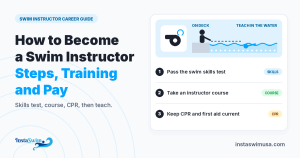
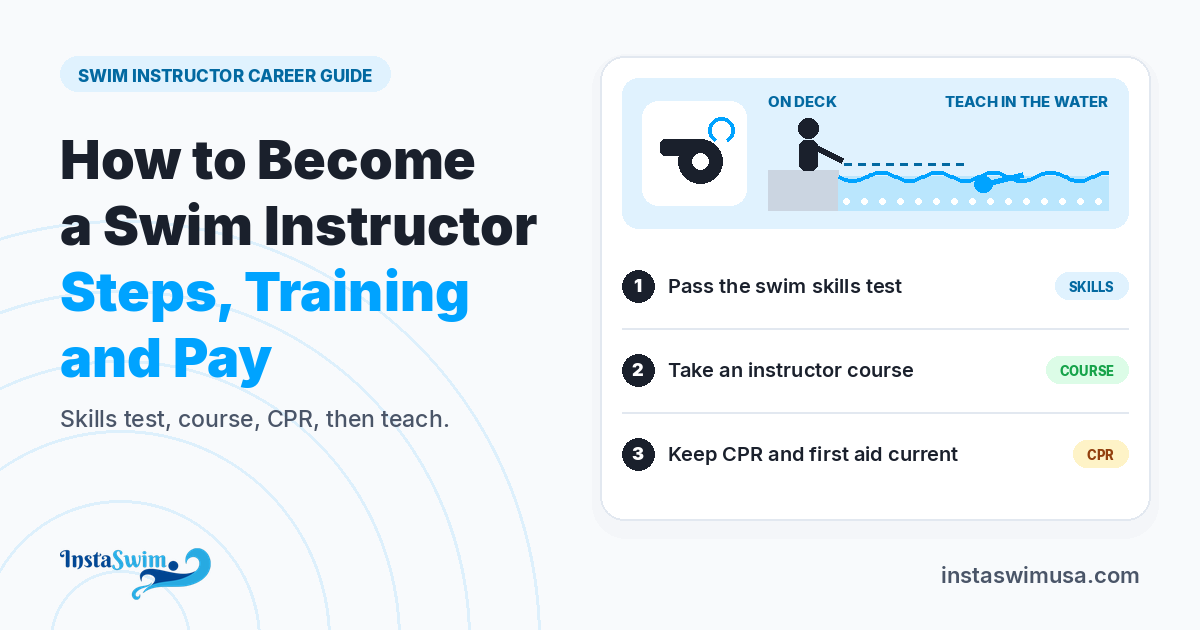
To become a swim instructor, be at least 16, pass a swim skills test, complete an instructor course such as the Red Cross Water Safety Instructor course (about 30 hours), and keep CPR and first aid current. Then choose a swim school, a pool, or private lessons as an independent instructor.
What a swim instructor actually does
A swim instructor teaches people how to be safer and more capable in the water. On a typical day that might mean helping a nervous three year old blow bubbles, coaching a ten year old through side breathing, or giving an adult beginner the confidence to float on their back for the first time.
The work matters. The CDC reports that drowning is the leading cause of death for children ages 1 to 4 and that participation in formal swimming lessons can reduce the risk of drowning among children and young adults. Our drowning statistics report breaks those numbers down by age and state. Lessons are one layer of protection alongside supervision, barriers and life jackets, and good instructors teach water safety habits, not just strokes.
Where you teach shapes the job:
Swim school, Y or city pool
- Set schedule and class plans handed to you
- Mostly group classes
- Usually an employee with a set hourly wage
Private lessons
- One family or one swimmer at a time
- Often at a home, HOA or community pool
- Often as an independent contractor setting your own hours
- You handle scheduling, taxes and your own planning
Many instructors do both: a few group shifts at a local pool for steady hours, plus private lessons on evenings and weekends.
Swim instructor requirements
There is no single national license for swim instructors in the United States. Each employer, pool or platform sets its own requirements, and many look for a recognized instructor course plus current CPR. The American Red Cross publishes the requirements for its two instructor courses, which makes them a useful benchmark.
- Age. Both Red Cross instructor courses require you to be at least 16 by the last day of the course.
- Swim skills. You pass a precourse skills session before training starts. The bar depends on the course (see the table below).
- Course completion. You attend every session, complete practice teaching, and score at least 80 percent on the final written exam.
- CPR and first aid. Most pools and families expect a current certificate. Red Cross Adult and Pediatric First Aid/CPR/AED certificates are valid for two years. Our guide to learning CPR explains why it is part of water safety.
- Background checks. Many swim schools and recreation departments run their own checks for staff who work with children. Ask each employer what they require.
| Precourse skill | Basic Swim Instructor | Water Safety Instructor |
|---|---|---|
| Front crawl | 25 yards | 25 yards |
| Breaststroke | 25 yards | 25 yards |
| Elementary backstroke | 25 yards | 25 yards |
| Sidestroke | 25 yards | 25 yards |
| Back crawl | Not listed | 25 yards |
| Butterfly | Not listed | 15 yards |
| Water skills | Water competency sequence (submerge, float or tread 1 minute, turn, swim 25 yards, exit with no ladder) | Float or scull on back 1 minute, tread water 1 minute |
If a stroke on that list is rusty, practice it before you register. Both fact sheets list the precourse skills session as a requirement for continuing in the course.
How to become a swim instructor in 5 steps
Get your own strokes test ready
Swim the strokes in the table above at an easy, steady pace and time yourself treading water. Ask a coach or lifeguard to watch your form, because the precourse test looks at technique, not just distance.
Pick an instructor course
Choose the course that matches where you want to teach. The Red Cross Water Safety Instructor course covers the widest range, from parent and child classes to adult and private lessons. Many swim schools and Ys also run their own instructor training; ask what local employers recognize.
Add CPR and first aid
Take an adult and pediatric First Aid/CPR/AED course and put the renewal date on your calendar. A two year certificate lapses quietly if you forget it.
Get supervised teaching hours
Shadow an experienced instructor, help with group classes, or start with a local swim school. Real lessons teach things a course cannot: how to calm a crying toddler, how to talk to parents, and how to adjust a plan in the moment.
Decide where and how you will teach
Apply to schools and pools, offer private lessons, or both. Our guides to finding swim instructor jobs and choosing the right swim instructor job cover the search itself.
Comparing the two Red Cross instructor courses
The Red Cross offers two instructor paths. Both have the same minimum age and both certificates last two years. The difference is how much you can teach and how strong a swimmer you need to be going in.
| Detail | Basic Swim Instructor | Water Safety Instructor |
|---|---|---|
| Minimum age | 16 | 16 |
| Course time | About 2 hours online plus about 25 hours in class (2018 fact sheet) | About 30 to 31 hours, in person or blended online and in the pool |
| Stroke level for entry | Level 3 strokes | Level 4 strokes, including butterfly |
| What you can teach | Parent and Child Aquatics, Preschool Aquatics, Learn to Swim Levels 1 to 3, water safety presentations | All of those plus higher Learn to Swim levels, Adult Swim, Private Lessons and water safety courses |
| Passing score | 80 percent on the final exam | 80 percent on the final exam |
| Certificate length | 2 years | 2 years |
If you plan to teach private lessons to swimmers of all ages and abilities, the broader course gives you more room. If you mainly want to teach young beginners, the basic course may be enough for the pool you work at. Check with the employer before you pay for either.
What swim instructors earn
The Bureau of Labor Statistics does not publish a separate category for swim instructors, so the closest public benchmark is its category for fitness trainers and instructors. Treat these numbers as a reference point, not a forecast of what you will make.
- Median pay. BLS reports a median of $22.67 per hour ($47,160 per year) for fitness trainers and instructors in May 2025.
- The spread. In the May 2023 wage survey for exercise trainers and group fitness instructors, the middle half earned about $16.20 to $29.62 an hour, and the top 10 percent earned $38.82 or more.
- Outlook. BLS projects 7 percent employment growth for the occupation from 2025 to 2035, faster than the average for all occupations.
- The fine print. BLS wage estimates do not include self employed workers, which is how many private swim instructors work. Private lesson income depends on your rate, how many lessons you fill each week, travel time and the season.
For context on the family side, our swim lesson cost guide shows what families typically budget for private and group lessons. What a family pays per lesson is not the same as what an instructor takes home, since travel, taxes, pool fees and unpaid planning time all come out of it.
Plan for seasons. Kids lessons peak in spring and summer. Adult lessons tend to stay steadier through fall and winter at indoor pools, which can help fill the off season.
Teaching private lessons as an independent instructor
Many private swim instructors work for themselves. The IRS looks at the whole working relationship, including who directs and controls the work, to decide whether someone is an employee or an independent contractor. A person who provides services as a contractor is generally considered self employed.
In practice, working independently usually means:
- You set your own schedule and methods. You decide how you teach, which days you work and which families you take on.
- You handle your own taxes. Nobody withholds taxes from contractor payments. The IRS Self Employed Individuals Tax Center explains the basics, and a tax professional can help with your situation.
- You describe your own experience. Families read your profile, ask questions and decide whether you fit. Be specific and accurate about your training, the ages you teach and your approach.
- You think about pools and coverage. Private lessons often happen at a family's home pool or a pool they can access. Ask about pool rules, and look into whether you need your own liability insurance.
InstaSwim is a marketplace that connects families with independent swim instructors in their area. Instructors create their own profiles describing their experience and teaching style, and families choose who fits them. InstaSwim does not employ instructors or direct how they teach.
The skills that make families come back
Courses teach the mechanics. Repeat bookings usually come from softer skills that parents notice right away:
- Patience with fear. Many beginners, young and old, start out scared. Moving at their pace builds trust faster than pushing.
- Clear updates for parents. A two minute recap after each lesson (what went well, what to practice) keeps families involved. Parents of minors usually stay present for private lessons, so talk with them, not past them.
- Safety habits you model. Check the pool area, keep the swimmer within reach, and teach entries and exits along with strokes.
- Reliability. Showing up on time and confirming the next lesson matters as much as technique.
- Teaching to the person. A toddler, a teen and a 50 year old beginner need very different lessons, even if the skill is the same.
Frequently asked questions
How long does it take to become a swim instructor?
The Red Cross Water Safety Instructor course takes about 30 hours, often spread over a few weekends, and the Basic Swim Instructor course takes about 27 hours including the online portion. Add time to practice for the skills test and to take CPR and first aid. How quickly you finish mostly depends on when courses run near you.
Do you need a certification to teach swim lessons?
There is no single national license in the United States, but most swim schools, pools and many families expect a recognized instructor course and current CPR and first aid. Requirements vary by employer and location, so check before you apply or start teaching.
How old do you have to be to be a swim instructor?
The Red Cross Water Safety Instructor and Basic Swim Instructor courses both require candidates to be at least 16 by the last day of the course. Some employers set a higher minimum age, especially for private lessons.
How much do swim instructors make?
BLS does not track swim instructors separately. Its closest category, fitness trainers and instructors, had a median of $22.67 per hour in May 2025. Private lesson income varies widely with your rate, location, season and how many lessons you teach each week.
Can you teach private swim lessons on your own?
Yes. Many private instructors work as independent contractors, setting their own schedule and methods. That usually means handling your own taxes, describing your experience accurately to families, and checking pool rules and insurance needs before you start.
Do swim instructors need to be lifeguards?
Not always. The Red Cross instructor course fact sheets do not list lifeguard training as a prerequisite. Some pools and swim schools do ask for it, and nearly all expect current CPR and first aid, so ask each employer what they require.
Ready to teach on your own terms?
InstaSwim connects independent swim instructors with families looking for private lessons near them. Create a profile in your own words and let families choose who fits.
Join the InstaSwim NetworkSources
- American Red Cross, Water Safety Instructor Course Fact Sheet. Minimum age, precourse skills, course hours, passing score, program areas and 2 year certificate.
- American Red Cross, Basic Swim Instructor Course Fact Sheet (2018). Minimum age, precourse skills, course hours, program areas and 2 year certificate.
- American Red Cross, Adult and Pediatric First Aid/CPR/AED. Certificate valid for two years.
- U.S. Bureau of Labor Statistics, Occupational Outlook Handbook: Fitness Trainers and Instructors. May 2025 median pay and 2025 to 2035 outlook.
- U.S. Bureau of Labor Statistics, Occupational Employment and Wages, May 2023: Exercise Trainers and Group Fitness Instructors. Hourly wage percentiles; excludes self employed workers.
- Internal Revenue Service, Independent Contractor (Self Employed) or Employee?. How worker status is decided and who is generally self employed.
- Centers for Disease Control and Prevention, Drowning Facts. Drowning as the leading cause of death for ages 1 to 4; formal lessons can reduce drowning risk.
About this guide
Compiled by the InstaSwim team in November 2026 from American Red Cross course fact sheets, U.S. Bureau of Labor Statistics data, IRS guidance and the CDC. Course hours and requirements change; confirm current details with the course provider before you register. BLS pay figures describe a related occupation, exclude self employed workers and are not a prediction of any instructor's income. Nothing here is tax or legal advice. Instructors on the InstaSwim platform are independent contractors who describe their own methods and experience, and families decide who fits them. Swim lessons are one layer of protection and no lesson makes anyone drown proof. This guide is general information and is not medical advice.