Swimming With Migraines: How to Keep Headaches Out of the Pool
Swimming with migraines can feel like a gamble. Laps are supposed to clear your head, yet some days you climb out with a pounding headache, sore eyes and a long afternoon ahead. If you live with migraine and want to learn to swim, get back to the pool, or simply understand why the water sometimes sets you off, you are asking a fair question.
This guide pulls together what health sources say about migraine and exercise, the pool specific things that can bring on a headache, how to tell a goggle headache from a migraine, and a practical plan many swimmers use. It does not diagnose anything. Your doctor knows your pattern, your medicines and your limits.
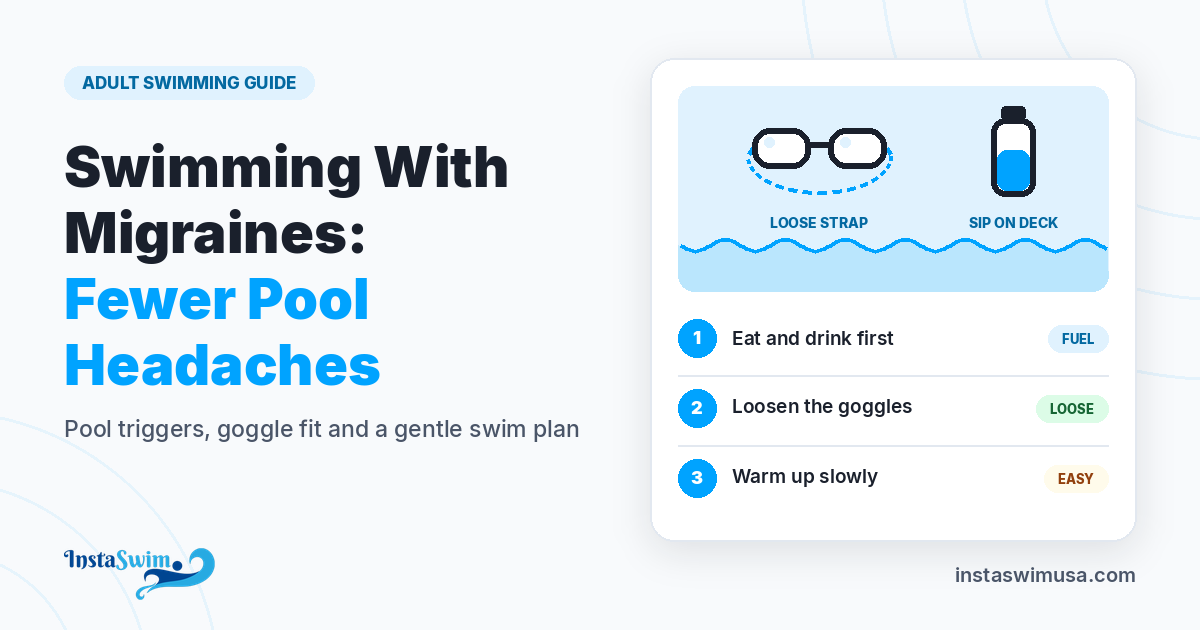
Many people with migraine can swim, and regular exercise may even reduce attacks over time. Common pool triggers are tight goggles, an empty stomach, too little water, glare and a sudden hard effort. Eat first, drink on deck, loosen your goggles, build up slowly, and never swim alone during an aura.
What a migraine attack looks like
The NHS describes a migraine as a throbbing headache, often on one side of the head, that can get worse when you move around. It usually comes with nausea or vomiting and strong sensitivity to light and sound. An attack usually lasts between 4 hours and 3 days, and early signs can start hours, or even up to 2 days, before the pain.
Some people get an aura first. The NHS lists zigzag lines or flashing lights, pins and needles, dizziness and difficulty speaking as typical aura symptoms, and says aura should not last longer than 1 hour. For swimmers, aura matters more than the headache itself, because blurred vision or dizziness in deep water is a safety problem, not just a comfort one.
Migraine is common. In the 2018 National Health Interview Survey, the CDC found that 20.1% of women and 10.6% of men had a severe headache or migraine in the previous 3 months, which makes women nearly twice as likely to be affected. So if you are standing on the pool deck wondering about this, you have plenty of company.
Is swimming with migraines a good idea?
For many people, yes. The U.S. National Institute of Neurological Disorders and Stroke (NINDS) lists regular exercise among the habit changes that can reduce or prevent migraine episodes for some people. The Migraine Trust, a UK charity, names swimming alongside walking, cycling and dancing as aerobic options and says the key is building up gradually and staying consistent, rather than going hard.
The best known trial on this question was published in Cephalalgia in 2011. Researchers in Sweden randomized 91 adults with migraine to exercise for 40 minutes three times a week, a relaxation program, or the preventive medicine topiramate, for 3 months. Attacks dropped by an average of 0.93 per month in the exercise group, 0.83 with relaxation and 0.97 with topiramate, and the difference between groups was not significant. That is one study and a modest effect, but it suggests regular exercise belongs in the conversation.
The catch is that exercise can also be a trigger. In a 2013 study of 103 patients at a Dutch headache clinic, 38% said exercise had brought on a migraine attack at some point. More than half of them had stopped the activity that caused it. The authors noted that a clinic group may not reflect everyone with migraine, but the message is clear: exercise helps many people, and the way you exercise matters.
What tends to help
- Regular, steady sessions at a similar time of day
- A small snack and water before you swim
- Easy warm up laps before any harder sets
- Loose, soft goggles and a relaxed neck
What tends to set it off
- Swimming on an empty stomach
- Long sessions without drinking
- Jumping straight into hard, fast sets
- Tight goggles, glare and very cold water
Why the pool can set off a headache
NINDS lists common migraine triggers that include physical strain, low blood sugar or skipped meals, bright or flashing lights, sleep changes, stress and sudden changes in your environment. The National Headache Foundation adds that dehydration, extreme temperatures and poor fueling can trigger migraine during exercise. A swim session can stack several of these at once, which is why the pool can feel worse than a walk.
| Possible trigger | How it shows up at the pool | What many swimmers try |
|---|---|---|
| Goggle pressure | A tight strap or hard seals pressing on the forehead and temples | Loosen the strap, switch to softer seals, change where the strap sits |
| Low blood sugar | Early morning laps before breakfast, or a long gap after lunch | A small snack 1 to 2 hours before you get in |
| Dehydration | You sweat in the water but rarely feel thirsty | A water bottle on deck and sips between sets |
| Sudden hard effort | Racing the first length or a fast interval set with no warm up | Easy laps first, then build effort over weeks, not minutes |
| Glare and bright light | Sun on outdoor water, or strong lights over an indoor pool | Tinted or mirrored goggles, a lane facing away from the sun |
| Temperature | Very cold water, or a hot, humid indoor pool hall | Ease into cold water slowly, take breaks in a cooler spot |
| Neck tension | Lifting the head high to breathe or keeping the neck stiff | A relaxed head position and smooth side breathing |
Neck tension is worth a closer look. In the Dutch study, people with exercise triggered attacks were more likely to say neck pain was the first sign of their usual attacks (33% compared with 14%). That does not prove swimming technique causes migraine, but a stiff neck and a high head position are easy things to change with a little coaching.
Goggle headache, exercise headache or migraine?
Not every headache after swimming is a migraine. Headache specialists use the International Classification of Headache Disorders (ICHD-3) to sort them, and two other types are common in swimmers.
| Type | Typical pattern | What it points to |
|---|---|---|
| External compression (goggle) headache | Starts within 1 hour of pressure on the forehead or scalp and fades within 1 hour after the pressure is removed | Goggle or cap fit. ICHD-3 names swim goggles as an example |
| Primary exercise headache | Comes on only during or after strenuous exercise and lasts under 48 hours | Effort level. The first one needs a doctor to rule out a serious cause |
| Migraine attack | Throbbing pain, often one sided, with nausea and light or sound sensitivity, lasting 4 hours to 3 days | Your usual migraine pattern, possibly set off by the session |
If your headache fades quickly once the goggles come off, fit is the first thing to fix. U.S. Masters Swimming suggests a looser strap, softer rubber and moving the goggles to different positions so the same spot is not pressed every time. Goggles that sit on or above the brow, more like a dive mask, are often more comfortable for people with migraine.
Exercise headaches are different. Mayo Clinic lists swimming among the activities linked to them and says the harmless primary type lasts from about 5 minutes to 48 hours. It also says to call a doctor right away if a headache starts abruptly or is your first headache of that kind, and ICHD-3 says a bleed in the brain must be ruled out the first time it happens. Vomiting, fainting, double vision or a stiff neck point to a cause that needs medical attention.
Questions to settle with your doctor
A short conversation before you start a swim routine saves guesswork later. Questions worth bringing:
- Is regular swimming a good fit for my type of migraine? Your doctor may suggest how to build up and what to watch for.
- Is it safe for me to swim if I feel an aura starting? For most people the answer is to get out, but ask what your own plan should be.
- Do any of my medicines affect swimming? Some people feel drowsy or dizzy on certain treatments. Ask about timing around a swim.
- What should I do if I get a headache in the pool? Agree on when to rest, when to take a rescue medicine, and when to call.
- Which new headache patterns should I report? A first exercise headache or a sudden, severe one is a reason to call, not wait.
If dizziness is part of your migraine, our guide to swimming with vertigo covers shallow water, staying near the wall and what to do in a dizzy spell.
A migraine friendly swim plan
None of this is a cure. It is a set of habits that removes the most common pool triggers so you can find out what your body actually tolerates.
Eat and drink first
The Migraine Trust suggests eating enough before exercise to avoid a dip in blood sugar, leaving 1 to 2 hours to digest, and drinking before, during and after a session. Keep a bottle at the end of your lane.
Fit your goggles before you get in
Adjust the strap so the seal holds with light pressure, not a squeeze. If you wear contacts or need a prescription, our guide to swimming with contacts compares the options. Tinted lenses help with glare outdoors.
Warm up and build slowly
Start with several easy lengths. Add time or speed over weeks. If hard sets have triggered attacks before, keep effort conversational until you know your limit.
Keep a steady routine
Swim at a similar time of day and keep sleep and meals regular around it. A simple log of swim days, food, water and headaches helps you and your doctor spot patterns.
Never swim alone
The CDC advises always swimming with a buddy and choosing places with lifeguards when possible. That matters even more when an aura or a wave of nausea could come on without warning.
If an attack or aura starts in the water
Have a plan before you need it, and tell your swim buddy what it is.
- Head for the wall or steps. Stop your set at the first sign of aura, blurred vision, dizziness or rising nausea.
- Tell someone. Let your buddy or the lifeguard know you are getting out and why.
- Rest somewhere cool and dim. Light and noise can make an attack worse. Sip water and follow the plan your doctor gave you.
- Do not get back in until it is over. Do not drive while your vision is affected or you feel drowsy.
Call 911 if a headache comes on suddenly and is extremely painful, or comes with trouble speaking or remembering, loss of vision or double vision, confusion or drowsiness, a seizure, weakness on one side of the body or face, a very high temperature, or a recent head injury. These are among the warning signs the NHS lists for emergency help.
Swim lessons when you live with migraine
Many adults who live with migraine never learned to swim, or stopped because the pool kept ending in a headache. Lessons can help with both. A good instructor can work on a relaxed head position, smooth breathing and pacing, which are exactly the habits that keep strain down. Our guide to learning to swim as an adult covers what to expect when you start later in life.
On InstaSwim, the booking form asks about health and any special needs so the instructor knows before the first lesson, and details are shared directly between you and your instructor. You decide, with your doctor where appropriate, whether you can safely take part. Instructors on the platform are independent contractors who describe their own experience on their profiles, so read profiles closely and ask questions that matter to you:
- Can we start each lesson with easy laps and keep the effort steady at first?
- Are you comfortable with me stopping at the first sign of an aura and finishing early if needed?
- Can we work on breathing and head position to keep my neck relaxed?
Lessons take place at your own pool or one you have access to, such as a community, HOA, apartment or gym pool, so a quiet time of day with less glare and noise is often easier to arrange. For budgeting, see our swim lesson cost guide, and for why adult water skills matter, our drowning statistics report has the national data.
Frequently asked questions
Can swimming trigger a migraine?
It can for some people. In a 2013 study of 103 migraine clinic patients, 38% said exercise had triggered an attack at least once. In the pool, common culprits are tight goggles, swimming on an empty stomach, too little water, glare, very cold water and starting too hard. Fixing these often helps.
Why do I get a headache after swimming?
Common reasons include goggle pressure, dehydration, low blood sugar, neck tension from a high head position and hard effort. A goggle headache usually fades within an hour of taking the goggles off. A headache that starts suddenly and severely, or is your first of its kind during exercise, needs prompt medical advice.
Can swim goggles cause headaches?
Yes. The International Classification of Headache Disorders names swim goggles as an example of external compression headache, which starts within an hour of the pressure and fades within an hour after it is removed. A looser strap, softer seals and changing where the goggles sit often help.
Is swimming good for migraines?
Regular aerobic exercise, including swimming, may reduce how often attacks happen for some people. In a 2011 trial, 40 minutes of exercise three times a week cut attacks about as much as the preventive medicine topiramate. Results vary, so build up gradually and talk with your doctor.
Should I swim during a migraine attack?
Most people are better off resting. An attack often brings nausea and light sensitivity, and aura can blur vision or cause dizziness, which is unsafe in water. Get out at the first sign, rest somewhere cool and dim, and follow the plan your doctor gave you.
Can kids with migraines take swim lessons?
Many can. Talk with your child's doctor about their triggers and plan, give the instructor the details before the first lesson, pack a snack and water, and check goggle fit. A parent or guardian stays present for lessons with minors, so you can step in if your child feels unwell.
Swim on your terms, at your pace
Browse independent instructors near you, read their profiles, and choose someone whose approach fits how you want to learn.
Find Instructors Near YouSources
- NHS, Migraine: Symptoms. Attack symptoms, 4 hour to 3 day duration, aura under 1 hour, emergency warning signs.
- National Institute of Neurological Disorders and Stroke, Migraine. Common triggers and exercise as a habit that may reduce episodes.
- CDC National Center for Health Statistics, QuickStats: Severe headache or migraine in the past 3 months (2018 NHIS). 20.1% of women and 10.6% of men.
- Varkey E, et al. Exercise as migraine prophylaxis: a randomized study using relaxation and topiramate as controls. Cephalalgia (2011). 91 adults, 40 minutes three times a week, attack reductions by group.
- Koppen H, van Veldhoven PLJ. Migraineurs with exercise triggered attacks have a distinct migraine. Journal of Headache and Pain (2013). 38% lifetime exercise triggered attacks, neck pain onset finding.
- International Classification of Headache Disorders (ICHD-3), 4.6.1 External compression headache. Swim goggles as an example, 1 hour onset and resolution.
- ICHD-3, 4.2 Primary exercise headache. Under 48 hours, serious causes ruled out at first occurrence.
- Mayo Clinic, Exercise headaches. Swimming among linked activities, 5 minutes to 48 hours, when to call a doctor.
- The Migraine Trust, Migraine and exercise. Eating and drinking before exercise, building up gradually, swimming as an aerobic option.
- National Headache Foundation, HeadWise Episode 243: How exercise affects migraine (2026). Dehydration, temperature and fueling as exercise triggers.
- U.S. Masters Swimming, Alleviate annoying goggle headaches (2016). Strap tension, softer rubber and goggle position.
- CDC, Preventing Drowning. Swim with a buddy and choose sites with lifeguards when possible.
About this guide
Compiled by the InstaSwim team in November 2026 from the NHS, NINDS, CDC, the International Classification of Headache Disorders, Mayo Clinic, The Migraine Trust, the National Headache Foundation, U.S. Masters Swimming and two peer reviewed studies. Study figures come from small groups and may not apply to everyone with migraine; the trigger table lists common patterns, not a checklist that fits every person. Instructors on the InstaSwim platform are independent contractors who describe their own methods and experience, and they cannot give medical advice. Swim lessons are one layer of water safety, not a replacement for supervision and a swim buddy. This guide is general information and is not medical advice. Talk with your doctor about your own migraine and exercise plan.