Swimming After Hernia Surgery: How Long to Wait and How to Start
Swimming after hernia surgery is one of the first things many adult swimmers ask about once the stitches are in. Walking is encouraged, lifting is off limits, and the pool sits somewhere in between: it is gentle on the joints, but it also means soaking a fresh wound and using the same core muscles the repair needs time to settle into.
This guide pulls together what the NHS, MedlinePlus, the American College of Surgeons and hospital discharge leaflets say about getting back in the water, how the wait can differ by type of repair, a calm first swim plan, and the signs that mean you should get out and call your surgeon. It does not replace your discharge papers. Your own surgical team knows exactly what was done and when you can safely swim.
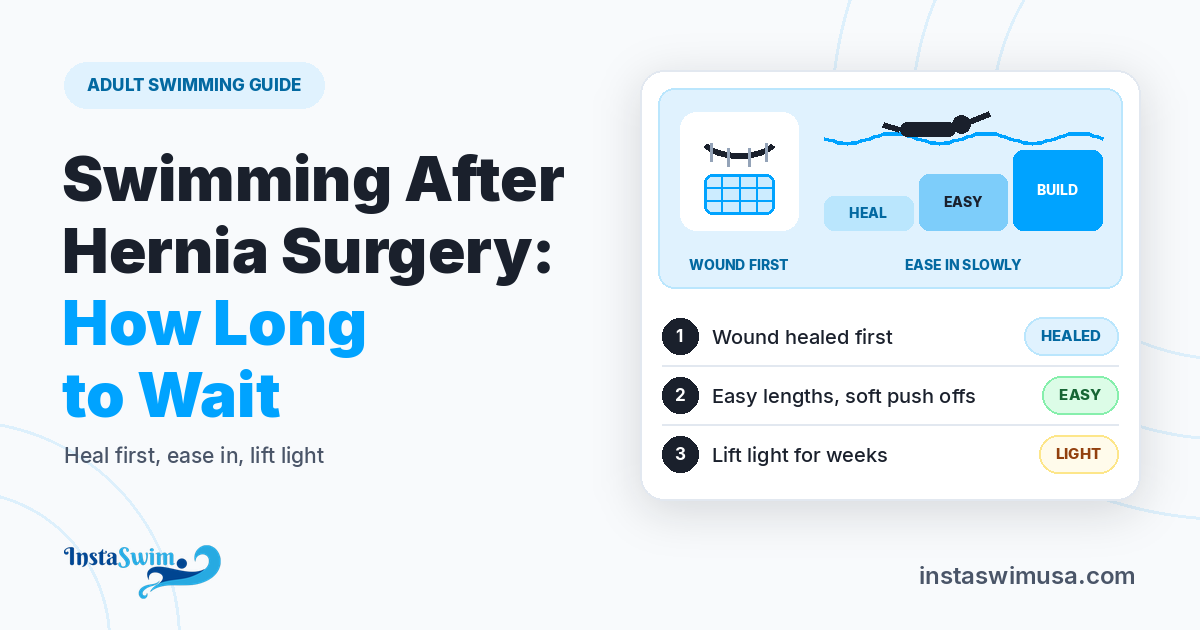
Most people can swim once the wound has fully healed, which the NHS says usually takes about 2 weeks. Start with easy lengths, and save hard kicking, strong push offs and heavy lifting until your surgeon clears strenuous activity, often 4 to 6 weeks after a groin repair.
How long to wait before swimming after hernia surgery
There is no single date that fits everyone, but the major sources land in a similar place. The common thread is that the wound comes first. A pool, a lake or a hot tub means soaking the incision, and that waits until the skin has closed and your team is happy with it.
- NHS (inguinal repair). Do not bath or swim until the wound has healed, which usually takes about 2 weeks. Showering is usually fine from a few days after surgery with a waterproof dressing.
- MedlinePlus (U.S. National Library of Medicine). Do not take a bath, soak in a hot tub or go swimming for the first week after inguinal hernia repair, and check with your surgeon before returning to sports.
- Cardiff and Vale University Health Board (umbilical repair). Do not bathe, swim or soak in water for 2 weeks. Showering is fine.
- American College of Surgeons (groin repair). Do not soak in a bathtub until stitches, strips or staples are removed. The leaflet does not give a separate swimming date.
- U.S. Masters Swimming. An article for adult swimmers notes that most doctors advise waiting at least two weeks before getting the wound wet, and some people are told to stay out of the water for at least a month.
Getting the wound wet and swimming hard are two different milestones. The table below sets them side by side so you can see the difference.
| Milestone | Typical guidance | Source |
|---|---|---|
| Shower | From 24 hours to a few days, often with a waterproof dressing | NHS, Guy's and St Thomas', ACS |
| Walking and light activity | Right away, building up slowly | NHS, MedlinePlus |
| Swim, bath or soak | Once the wound has healed, usually about 1 to 2 weeks | NHS, MedlinePlus, Cardiff and Vale |
| Strenuous exercise and heavy lifting | 2 weeks (keyhole) to 4 weeks (open) at one NHS hospital; at least 4 to 6 weeks in NHS and ACS guidance | Guy's and St Thomas', NHS, ACS |
| Heavy lifting after belly button repair | 6 to 8 weeks | Cardiff and Vale |
| Complex or repeat repairs | Lifting limits can last up to 6 months | ACS |
Notice the gap between the highlighted row and the rows under it. For many people there is a stretch of a few weeks where easy swimming may be fine but hard training is not. That middle stretch is where a gentle plan matters most.
Keyhole, open and belly button repairs
The NHS explains that keyhole (laparoscopic) surgery uses a few small cuts near the belly button and lower tummy, while open surgery uses one larger cut in the groin. Which one you have depends on the hernia's size and location and on your general health.
Keyhole repair
- Several small cuts rather than one larger one
- Guy's and St Thomas' advises avoiding heavy lifting and strenuous exercise for 2 weeks
- The 2023 HerniaSurge guidelines link it with a faster return to normal activities and work than open repair
Open repair
- One larger cut in the groin
- Guy's and St Thomas' advises avoiding heavy lifting and strenuous exercise for 4 weeks
- NHS and ACS guidance for groin repairs says at least 4 to 6 weeks before heavy lifting or strenuous activity
Belly button (umbilical) repairs follow their own leaflets. The Cardiff and Vale discharge advice says no swimming or soaking for 2 weeks and no heavy lifting or strenuous activity for 6 to 8 weeks. Larger abdominal wall and incisional repairs can come with longer limits, so go by the instructions your own team gave you.
Why the wait matters
Two separate things need time, and they heal on different clocks.
The skin on the outside
Pool water, lakes and hot tubs are not sterile. Keeping a fresh incision out of the water until it has closed lowers the chance of infection. This is the reason behind the usual 1 to 2 week wait.
The repair on the inside
The muscle and tissue around the repair take longer to settle than the skin does. That is why lifting and strenuous exercise limits run to several weeks even when the wound looks fine. A hard kick set or a powerful push off asks a lot of the core and the groin.
Your energy
MedlinePlus notes that most people will not feel like doing anything strenuous for a few weeks. The American College of Surgeons says patients usually take 2 to 3 weeks to return comfortably to normal activity. Tired swimmers make sloppy choices, so short sessions help.
Signs you may be ready, and signs to wait
Signs you may be ready
- Your surgeon or nurse has said swimming is fine
- The wound is closed and dry, with no scabs or open spots
- Stitches, staples or strips are out or have come off as advised
- You can walk, climb stairs and get in and out of a car comfortably
Wait and ask first
- Any redness, warmth, swelling or discharge from the wound
- A fever, or pain that is getting worse instead of better
- You had a complex, large or repeat repair
- You are still taking strong pain medicine that makes you drowsy
A gentle first swim plan
Once you have the go ahead, think of the first few sessions as a test drive. The goal is to find out how your body feels in the water, not to make up for lost training.
- Carry less. MedlinePlus and the ACS both say not to lift anything over 10 pounds for 4 to 6 weeks, or until your surgeon says it is OK. A wet towel, kickboard and full bag add up, so pack light or ask someone to carry it.
- Use the steps. Walk in by the steps or a ladder instead of jumping or hauling yourself up over the edge. Getting out takes more effort than getting in, so plan for it.
- Start by walking in the water. A few minutes of walking in chest deep water lets you check for pulling or pain before you swim.
- Choose smooth, easy strokes. Many swimmers start with relaxed freestyle or backstroke with a small, steady kick. If any stroke or kick pulls at the groin or incision, drop it for now.
- Go easy on walls. Open turns and soft push offs are kinder to a healing core than flip turns and explosive starts. Save those for after your surgeon clears strenuous exercise.
- Keep it short. Stop the first session while you still feel good. Add time before you add effort.
- Skip the hot tub for now. MedlinePlus and the Cardiff and Vale leaflet group hot tubs and jacuzzis with swimming, so the same wound rule applies.
- Check in the next day. A little tiredness is normal. New or sharper pain, or swelling around the repair, means you did too much.
Do not swim alone while you recover. Feeling weak or sore in the water is a different problem from feeling sore on land. Swim where a lifeguard or a capable adult is watching. Swimming skills are one layer of protection, and supervision is another. Our drowning statistics report explains why that matters for adults as well as children.
When to stop and call your surgeon
Get out of the water and contact your surgical team or a doctor if you notice any of these. The list draws on the NHS, MedlinePlus and the American College of Surgeons.
- Wound changes. The incision is bleeding, painful, swollen, warm or red, or has pus or bad smelling drainage.
- Fever. MedlinePlus and the ACS name a temperature of 101°F (38.3°C) or higher. The NHS also lists feeling hot, cold or shivery.
- Pain that is getting worse. Pain or soreness that is severe, or a swollen tummy that keeps getting worse.
- Swelling or pain in the scrotum or testicles that is getting worse, or trouble passing urine.
Emergency signs: The ACS warns that sharp abdominal pain with vomiting may mean the intestine is trapped, which is a surgical emergency. The NHS also lists severe difficulty breathing and chest or upper back pain as reasons to call emergency services. Do not wait to see if these pass.
Swimming with a hernia before surgery
Some people live with a hernia for months while they wait for an operation, or choose to watch and wait. The NHS describes a hernia as part of an organ, such as the bowel, pushing through a weak spot in the muscle. Its hernia page encourages being physically active as a general habit, but it does not give specific rules for exercise with an unrepaired hernia.
U.S. Masters Swimming calls swimming one of the best exercises for people with a hernia because it is low impact, and it advises talking to your doctor about how much you can swim both before and after surgery. Watching and waiting is not always a long term plan. NIDDK says about 70 percent of men who delay surgery will develop new or worsening symptoms and need surgery within 5 years, while the ACS leaflet says half of men in watchful waiting had crossed over to surgery after 5 years. Either way, it is worth having the conversation early.
The NHS says pain in or around a hernia can be a sign of strangulation and needs prompt medical help. If your hernia becomes painful, get out of the pool and get checked.
Swim lessons and pool days for families
Hernia repairs are not only an adult story. Children have them too, and MedlinePlus says a child may be back at school or daycare as soon as 2 to 3 weeks after surgery. Your child's surgeon will give the swimming date. Our guide to swimming with stitches or a cast covers how to think about wounds and water for kids.
If you are the one recovering, plan around the lifting rule. Lifting a toddler out of the pool, carrying a tired child up the steps or hauling a full pool bag can all go past 10 pounds. Ask another adult to handle the lifting for a few weeks.
If you are an adult learner or returning swimmer, a private lesson can be a calm way back in. A few practical points:
- Tell your instructor about the surgery. The InstaSwim booking form asks about health and needs so the instructor knows beforehand. Share your surgeon's limits directly with them, including any strokes or movements to skip.
- Choose who fits you. Instructors on InstaSwim are independent contractors with self described profiles. Read each profile and ask how they would adapt a lesson for someone returning after surgery.
- Keep the goals small. Early sessions can focus on breathing, body position and relaxed strokes instead of speed. If your core feels stiff or sore in the back, mention that too.
- New to swimming? Starting later is common. Our guide to learning to swim as an adult covers what to expect, and the swim lesson cost guide shows typical prices for private lessons.
You and your doctor decide whether you are ready to take part. An instructor can adjust the lesson, but your surgeon's advice comes first.
Frequently asked questions
How long after hernia surgery can I go swimming?
Most guidance says to wait until the wound has fully healed. The NHS says that usually takes about 2 weeks, and MedlinePlus says no swimming for at least the first week after inguinal repair. Easy swimming often comes before hard training, which many people need to hold off on for 4 to 6 weeks. Your surgeon gives the final date.
Is swimming good exercise after hernia surgery?
Swimming is low impact, and U.S. Masters Swimming calls it one of the best exercises for people with a hernia. After surgery it can be a gentle way to rebuild fitness once the wound has healed and your surgeon agrees. Start with short, easy sessions and avoid hard kicking and strong push offs until strenuous exercise is cleared.
Is the wait different after keyhole and open hernia repair?
Often, yes. Guy's and St Thomas' NHS Foundation Trust advises avoiding heavy lifting and strenuous exercise for 2 weeks after keyhole repair and 4 weeks after open repair, and the 2023 HerniaSurge guidelines link keyhole repair with a faster return to normal activities. The wound still needs to heal before swimming either way.
Can I use a hot tub after hernia surgery?
Not straight away. MedlinePlus says not to soak in a hot tub for the first week after inguinal repair, and the Cardiff and Vale umbilical hernia leaflet says no jacuzzi or soaking for 2 weeks. Treat a hot tub like swimming and wait until the wound has healed and your surgeon says it is fine.
Can I swim with a hernia that has not been repaired?
It depends on your hernia, so ask your doctor first. U.S. Masters Swimming advises talking with your doctor about how much you can swim before and after surgery. The NHS says pain in or around a hernia can be a sign of strangulation, so get out of the water and seek help if your hernia becomes painful.
What signs mean I should stop swimming and call my doctor?
Stop and call if the wound becomes red, warm, swollen, painful or leaks pus, if you have a fever of 101°F (38.3°C) or higher, or if pain or swelling keeps getting worse. The American College of Surgeons warns that sharp abdominal pain with vomiting may be a surgical emergency.
Ease back into the water at your own pace
Browse independent swim instructors near you, read their self described experience, and choose the one who fits your goals and your recovery.
Find Instructors Near YouSources
- NHS, Inguinal hernia repair. Wound healing and swimming, showering, lifting, work, keyhole and open surgery, warning signs.
- NHS, Hernia. What a hernia is, types, and pain as a possible sign of strangulation.
- MedlinePlus, Inguinal hernia repair: discharge. No swimming or hot tub for the first week, 10 pound lifting limit, children's return to school, when to call the doctor.
- Guy's and St Thomas' NHS Foundation Trust, Recovery after inguinal hernia repair. Lifting and strenuous exercise limits after keyhole and open repair.
- Cardiff and Vale University Health Board, Discharge information: abdominal hernia. Swimming, soaking and lifting limits after umbilical repair.
- American College of Surgeons, Groin Hernia Repair patient education leaflet. Bathing, lifting limits, return to activity, warning signs and lifetime risk.
- NIDDK, Inguinal Hernia. Lifetime risk in men and women, recovery and watchful waiting.
- Stabilini et al., Update of the international HerniaSurge guidelines for groin hernia management, BJS Open (2023). Number of groin hernia repairs worldwide and recovery after keyhole repair.
- U.S. Masters Swimming, When Can I Swim After Hernia Surgery? (2023). Typical waits before getting the wound wet and swimming as low impact exercise.
About this guide
Compiled by the InstaSwim team in November 2026 from the NHS, MedlinePlus, two NHS hospital discharge guides, the American College of Surgeons, NIDDK, the 2023 HerniaSurge guidelines and U.S. Masters Swimming. Timelines differ between sources and between types of repair, so the ranges here are general planning estimates, not a schedule for your recovery. No source here tests swimming as part of hernia recovery, and the first swim plan is general practical advice to adapt with your surgical team. Instructors on the InstaSwim platform are independent contractors who describe their own methods and experience. Swimming skills are one layer of protection and never make anyone drown proof. This guide is general information and is not medical advice.